Showing posts with label The Funny Wonder. Show all posts

Wednesday, July 12, 2023

The First Funny Wonder Annual


The very first Funny Wonder book came out for 1935, a super-sized edition of the popular weekly comic published by Amalgamated Press. The comic began life in 1914... sort-of, and would continue until 1953. It was actually the second comic to have the name, the first of which was published in the 1890s by Harmsworth Brothers. I'll leave it at that as it's a long and confusing history that I am still wrapping my head around and is probably more deserving of its own post - all you need to know is this is from the second run.

Just from looking at it, I can tell this book would have stood out on any shelf of a 1930s newsagents. Look at the photo above and you can see just how bright it appears when compared to the regular weekly edition. Measuring an inch cover to cover it's also incredibly thick, with pages so heavy they are essentially cardboard.


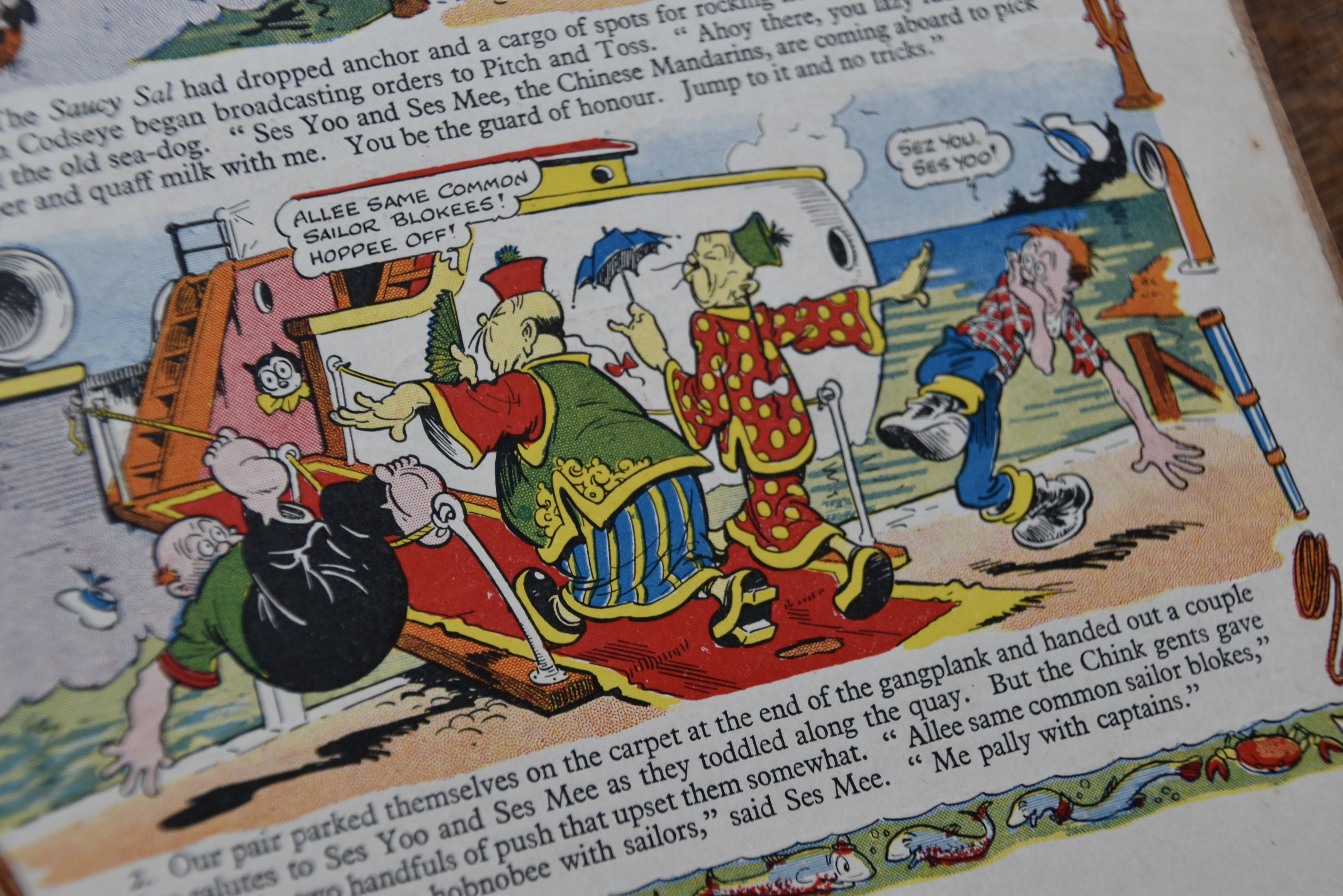
It cost 2/6, for which readers were treated to 110 pages (not counting the covers). Of those internal pages, nine were in colour, including this wonderful full-page gag illustrated by Roy Wilson. Wilson also drew that stunning front cover, of course.

Advertisements for the annual began appearing in The Funny Wonder in early September 1934. The editor, in the regular 'News From Your Editor' section published in #1069 (22nd September 1934) said "it is the funniest book on the market". 

"My dear readers - I wonder how many of you have seen the Funny Wonder annual for 1935? Those of you who have will know how jolly good it is!"

"Your old friends, Pitch and Toss and the Captain, appear inside, with a number of other fun-merchants and the stories are all written by your favourite Funny Wonder authors! All for half-a-crown!". 

Here are a couple of those adverts:


Moving along inside, and the next page we are greeted with is this letter from The Editor. I do wish the editor was named so I could tell you who it was, I also wonder if it is the same editor for the weekly comic. I assume it would be. I like this third paragraph here, promoting the "weekly blue-coloured paper The Funny Wonder".


The book is a wonderful mixture of stories, comics, puzzles and pictures - a fantastic annual that really utilises the space it has. For me, the highlights of this book are the full-page illustrations by Roy Wilson, the king of slapstick. There were two others printed throughout the book in addition to the full-colour one show above, both with black and red ink. Oh how I wish these were also printed in full colour, but of course doing so was expensive in 1934 and colour had to be used sparingly. Wilson was a master of the craft and I certainly haven't written enough about him on this blog. So significant was his work, and at such an important identity-forming time for British comics, I don't think it would be unfair to say that his style and legacy live on through artists working today.


There are plenty of text stories covering a variety of exciting genres, from far-away adventures to mysteries, this book has everything. Any child would have spent hours pouring through them, they really are fantastic. They vary in length so I'll show a shorter one - The Automatic Man. This has it all - a robot, a burglar, and a fat reward!


Before moving on, I feel I would be remiss if I didn't at least mention the racism in the comic. Sadly there are a couple of instances, shown below, where racial stereotypes were used. I get that such depictions were somewhat commonplace in comics of the time, but nonetheless they do dampen the comic when looking back. I'm glad times have changed.


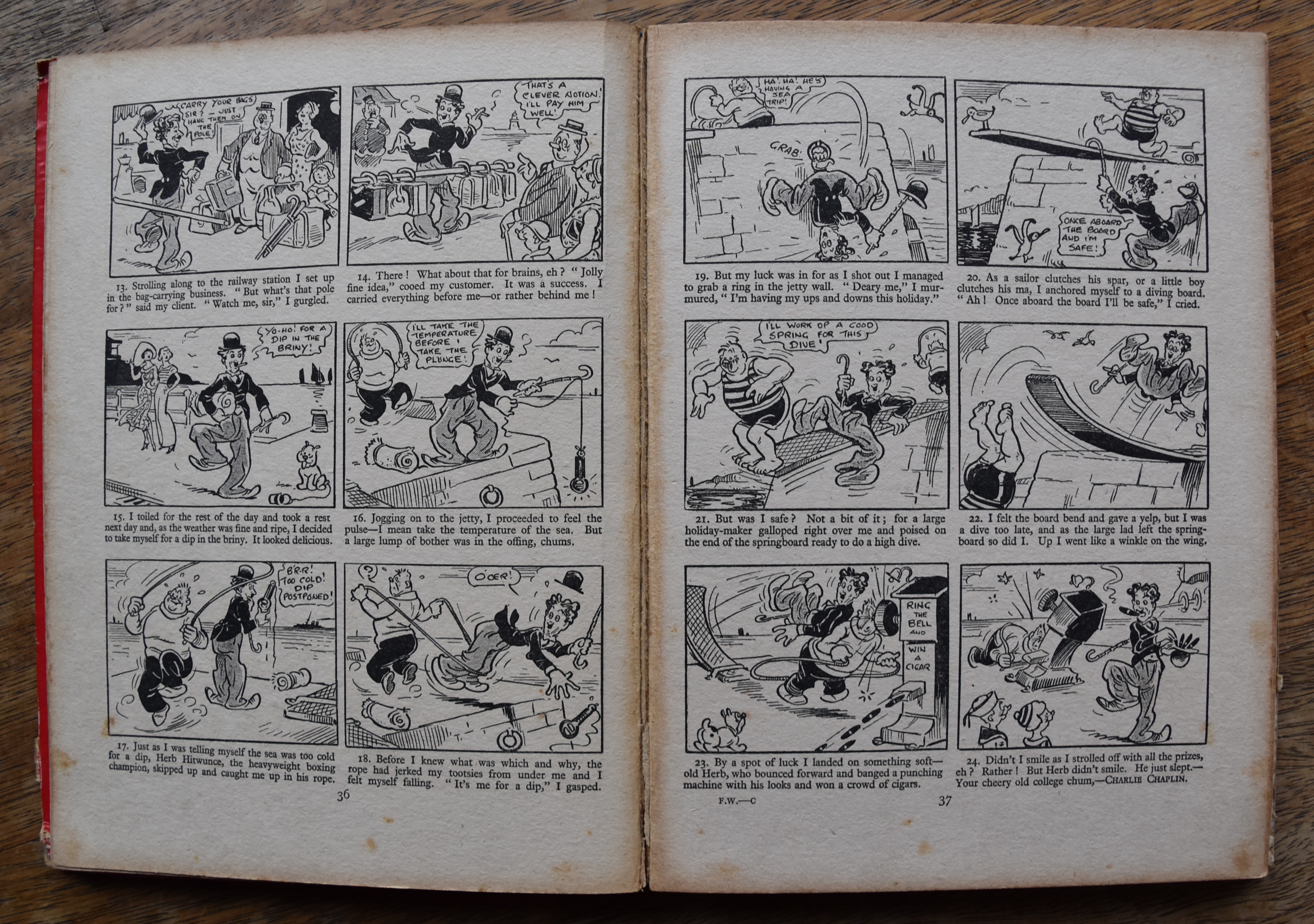
On a lighter note, here's a fun Charlie Chaplin comic strip, partially coloured in by a previous and enthusiastic owner of the book. Chaplin was a regular in The Funny Wonder at this point, with a comic strip on the centre spread every week. It's interesting that the comic has a summer beach theme, given the book was released with intentions of being a Christmas present. It works for those of us in the southern hemisphere, I suppose.


There's also a character called Pearl Pryor in the strip Pranks in the Park who looks incredibly like Keyhole Kate! No copyright claims can be upheld here of course as The Dandy, and Keyhole Kate, didn't arrive on the scene until 1937.


There's plenty more for readers of course but I'll wrap it up for this blog post. The last thing I want to share is this wonderful back cover, advertising various comics published by Amalgamated Press at the time. The Funny Wonder is on there, of course, alongside Larks, Jester, Jingles and Tip Top, each coming out on various days of the week. I love these early comics and wish they were easier to find copies of these days. I know if I had been alive in 1934 I would always be broke!

Monday, March 28, 2016

The Funny Wonder Secret Society


The Funny Wonder has a long and confusing publishing history that I won't be going into for this post, but I will bring to your attention this particular 'News From Your Editor' letter. Printed in the bottom corner of page two of the August 18th 1934 edition of the comic was an announcement regarding the 'Funny Wonder Secret Society'. To become a member was simple, all you had to do was wear the badge pictured in the centre of the letter and read The Funny Wonder. The "badge", featuring Charlie Chaplin, a Funny Wonder star since 1915, was nothing more than a piece of paper that readers were instructed to cut out of the comic, stick onto a piece of card and wear "through the buttonhole in the left lapel of the coat".

The only rule of the society was that you had to be a regular Funny Wonder reader. This could be tested every week with the password printed later on in the comic. A reader would ask anybody seen wearing the badge wearing that week's password, and if they couldn't give the correct reply they couldn't wear the badge. A fun idea, here's the example from this issue.


And here are a couple more examples from the following weeks, but I'm sure you get the point.


I'm not sure when the Funny Wonder Secret Society began, but I know it was before the issue the letter at the top of this post was printed in, as I have previous issues also with passwords at the back. The letter was probably printed every few months to allow new members to join; perhaps each letter brought with it a new badge design? If anybody has anymore information don't hesitate to get in touch!

Sunday, August 18, 2013

The Funny Wonder - It's Wonderfully Funny


It's not often I head back to comics pre-1950 on this blog, but today I'll be showing you some pages from The Funny Wonder, a comic which ran for two series from 1892 - 1901 and 1914 - 1942 (and it continued from then on under the name Wonder). I'll be showing you some pages from the second run.

The first issue I'll be showing comes from 1915, early in the run for the second series. As you can see, the cover star was Charlie Chaplin and I think this was his first appearance in the comic. Since the 75th Birthday issue of The Beano celebrities have taken over the comic. Many are unhappy about this change, stating "celebrities don't belong in comics". Whereas I agree there was a few too many, this example below should prove that they've always been appearing in them - I for one find this particular episode hilarious! This particular comic was part of Denis Gifford's 'Six Comics Of World War One' that was released in 1972. As always, click on the image to view in full size.


Moving inside and the majority of the contents is made up of text. One such story is All On His Own, which began in this issue and was spread over one and a half pages.


Move forwards to 1932 and Charlie is still the star of the cover, which is hardly surprising seeing how popular his films were and how popular they are now!


I won't be showing any more text stories but I will show some small humour strips from the center spread. Many comics had their center spreads filled with comic strips, and the front and back covers as well, with the rest of the comic filled with text. A classic layout that The Funny Wonder also followed.


Finally, we come forwards to 1939. As you can see, Charlie Chaplin had been replaced on the cover by a fat 'n thin duo who go by the names of Pitch and Toss.


Charlie still had his strip, but it was small and was hidden amongst others on the center spread.


Also to be found on the center pages was Little Elf - a strip remarkably similar to Little Plum.


I've reached the end of this blog post all-too-soon. I hope you've enjoyed these old comic strips, and hopefully I'll return to this era in the not too distant future.