Showing posts with label Denis Gifford. Show all posts

Monday, January 31, 2022

Oink! No. 13 (1986)

Oink! is one title I've thus far neglected to cover much on this blog, but hey - better late than never! So let's amend that with a dive into what is probably my favourite issue of one of the weirder comics published by IPC - lucky number #13. Launched in May 1986, Oink was still a fortnightly comic at this point (it would later go to monthly). Many people actually seem to consider Oink as "a Viz for children", indeed that is a phrase I have seen thrown around a lot, but it is simply not a true statement. I asked Tony Husband, one of the creators of Oink!, some years ago for something I was writing (and never finished) about whether the creation of a "Viz for children" was the intention of Oink, and this is what he had to say:

"No that was never our intention. The three of us, Pat Gallagher, Mark Rodgers and myself all wrote for the IPC comics and we just wanted to take the piss out of the formulated but enjoyable mainstream comics. We spoke to Bob Paynter who was the head of children's comics and he gave us money for a dummy. Years later John Brown publishing and the Donalds came to us about doing a kids Viz bit it never happened."

Oink! certainly is a comic unlike anything else put out by mainstream British comic publishers before. Those of you who've read Terry Bave's 2012 autobiography 'Cartoons and Comic Strips' may recall him discussing Krazy as, well, a "really crazy comic", where "a number of artists and writers had been invited to submit 'crazy' ideas, many turned out to be too crazy for consideration", and by Oink's standards Krazy would be considered somewhat traditional! (Krazy is another comic a little overlooked on this blog too, that may have to be amended soon as well.) To illustrate my point, here's a bizarre photo strip entitled Snatcher Sam meets Young Frankenstein. I can only imagine how much fun this would have been to produce. 

Issue thirteen is of course an unlucky number, well known to the Oink creators, and furthermore this issue was the very first Oink halloween issue - what a coincidence! For 30p readers got 32 pages, printed on nice glossy paper, 9 of those pages in full colour and a further 6 in partial colour with either a pink or yellow ink. That full-colour page count includes the poster on the centre spread, which is an absolutely stunning piece of artwork by the aforementioned Tony Husband featuring his popular character Horace (Ugly Face) Watkins, drawn in the style of a 1950s US horror comic cover. If it didn't mean taking apart an old comic I would definitely have this up on my wall. Perhaps a photocopy is needed...

Another interesting addition to this issue is this 3/4 page text piece Dennis Nifford's History of Horrors. Obviously, this is the pig alter-ego of famed comic historian Denis Gifford. I can only assume it was he who put this piece together, for as well as being a fan of comics he was very much involved with them. 

-- UPDATE! Thanks to Lew Stringer and other good ol' piggin' pals over at the Oink comic fan page on Facebook for informing me that actually this page is NOT by Denis Gifford as he was not a fan of Oink. In fact being an old school guy he didn't like any comics that didn't seem to follow the traditional style, such as 2000AD. I was very surprised to hear this, to say the least! The artwork is actually by Steve Gibson and potentially written by Steve as well, although if not it may have been Mark Rodgers. --

So what are some more of these weird and wacky strips I keep going on about? Well, what about this one entitled Billy's Brain. About a young boy called Billy and his uncle, who exists only as a brain, it's certainly not a strip I could see appearing in Buster or The Beano. It's unsigned but I think this is drawn by David Haldane.

Monster Mash is perhaps the funniest story in this issue. Illustrated by Lew Stringer and written by Mark Rodgers, it is a short story filled with brilliant gags - my favourite is the "school dinner disposal unit" wearing hazmat suits as they dump the toxic dinners into the "hidden dump". This is the first appearance of Pigswilla, a character who would appear a few times throughout Oink's run, and Lew talked about the character's creation in a post on his art blog. Here's what he had to say:

"Mark had originally sent me an idea for a story called The School Dinner Monster and asked if I had any ideas to add to it. I added a few bits and bobs to the plot and dialogue, and thought that the title Monster Mash was catchier. I gave the name 'Pigzilla' to the giant robot pig, although Mark changed that to the much more inspired Pigswilla."

Anyway, here's the two-pager. I really wish this had been given full colour treatment, as I feel it would really have made use of some disgusting school dinner colours to add some extra effect! In fact, another copy of Oink (#66) I happen to have to hand contains a full-colour, nine (!) page Pigswilla comic which I might have to share in a post here sometime soon, just for fun, and you'll see what I mean.

The last strip I'll share is a silly page that is perhaps a bit more 'normal' as far as IPC comics go, emphasis on a bit - The Curse of the Mummy, illustrated by Jeremy Banx. I say this one is a bit more normal only because it reminds me of a strip from the early days of Whizzer and Chips called The Mummy's Curse, in which two unlucky explorers are chased around the world by an angry mummy whose tomb they disturbed. I've also shared an example of that strip, taken from Whizzer and Chips #2 (25th October 1969) and illustrated by Reg Parlett.


Oink ran for about two and a half years before folding in October 1988. Sadly its unique appearance also made it somewhat controversial and some newsagents allocated it to the top shelf, above the eyes of children, and sales ultimately slumped and the plug was pulled (although I'm sure this wasn't the only reason). For those who want to read more about Oink I highly recommend Phil Boyce's excellent Oink blog, which has moved to a new home on Wordpress and can be found here: 

https://oink.blog

Wednesday, September 3, 2014

Fido #1 (1950)


I won't be surprised if you haven't heard of this comic before. Fido was a short-lived comic from 1950 published by Hotspur Publishing Co (as you can see above, they wrote 'A Hotspur Comic Book' on the front cover). Just four issues were produced and each had a different title. The first issue, the one I'll be looking at today, was entitled 'Fido the Pup'. Issue two is known as 'Fido's Fun', #3 as 'Fido at the Fair' and #4 as 'Fido at the Seaside'.  Each issue cost 3D for eight pages. The front and back covers were in full colour, as was the centre spread. Everything else was printed with blue ink. It was a lot smaller than I was expecting - I thought it had big A3 covers but instead it's very small - measuring 8" x 11". The front cover features, obviously, Fido himself, as well as a Micky the Monk short at the bottom. Denis Gifford illustrates both. This comic is aimed at a younger audience to titles such as The Beano. The Beano has an audience of 8 - 12 year olds however Fido had the upper limit set at 10 years, as the age limits on the competitions confirm.


Not only did the lucky pup have the comic named after him but had no less than four strips, one text story and also writes a short letter to the readers on page three. Also on the page are Tropical Tricks by Harry Banger and Willie Wander, another strip by Gifford.


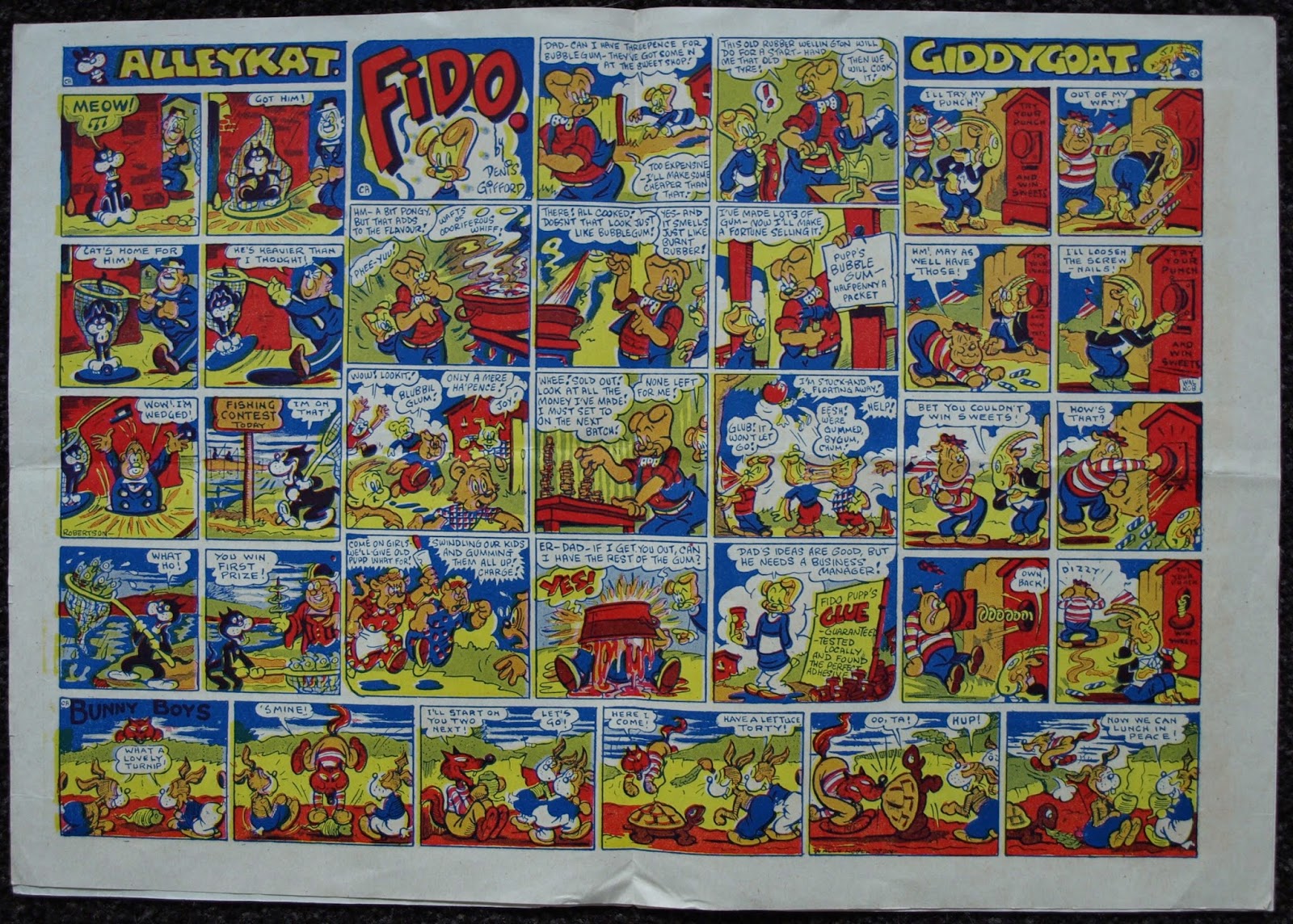
The centre spread is very bright but the number of colours used is very limited. Apart from another Fido strip (again illustrated by Gifford) this page also features Alleykat, Giddygoat and Bunny Boys, all by Wally Robertson


I'll wrap up this post with a half-page Polar Bear and Flippy strip, illustrated by Harry Banger (pronounced Bainjer). Banger is probably best remembered for his work on Gerald G. Swan's comics - I'd say Stoogie was his most famous character, who appeared on the cover of Coloured Slick Fun.


Thursday, August 28, 2014

The World's Comic #1,161 (1914)


According to Denis Gifford's book 'The British Comic Catalogue 1874 - 1974', The World's Comic ended on 10th November 1908 and merged into Funny Cuts the following week. This was not the case however, for I have a copy of the comic from 28th November 1914 - over six years after Denis claims it folded. I can't say whether he corrected this information in his 1985 book 'The Complete Catalogue of British Comics' because I don't own a copy, but I think The World's Comic actually ended sometime in 1915. I believe this because the front cover character, Bounderby Bouncer (also known as Bounderby Bounce) appeared on the cover of The Big Budget from 1899-1900 and then Funny Cuts from 1915-1918. I suspect he was revived for The World's Comic when WWI broke out (he was the "war correspondent") and then moved over into Funny Cuts when the two comics incorporated. That would just be my guess - can anybody confirm any dates?

The cover strip becomes quite racist with the third panel when Bouncer says "I was wending my way home in Buckingham Pal - well, towards my home, when I suddenly heard strange sounds. At first I thought I was near a pig-stye, but, listening more attentively, I recognised the sounds as German. Concealing myself, I approached, and I recognised two German spies." Ooer - that really reflects the times, doesn't it. The First World War had of course begun some months earlier so there was a most unfriendly attitude towards the Germans at the time - there are a lot of strips I've read from the period in which poorly disguised German spies are carrying around a large sheets of paper with "Der Plans" written on them in big bold letters, only to be easily defeated by some typical British character. This strip is somewhat different as Bouncer comes out worst here but usually characters are honoured with a medal or slap-up feed. It might just be my imagination, but to me Bounderby looks a lot like Ally Sloper in a military uniform.


Before we move on inside I thought I'd just quickly sum up the value of this comic. For 1D readers got an 8-page black and white comic that measured 11" x 14.5" and was printed on pink paper, but unusually 6 pages consisted of pictures and just two of text, instead of the familiar 50:50 ratio.

The two pages of text are made up of one text story entitled The Mystery of The Grey House written by H. Philpott Wright (probably a pseudonym). There is also a jokes and letters page that consists of a mixture of text and pictures so I've counted it as a picture page. I'll skip these pages and concentrate on the comic strips for this post, and what better way to do so than by showing the entire centre spread, which includes five comic strips and two picture jokes (I've counted the baby strip at the bottom as one picture).


Turn over and opposite Smiles from Everywhere (the jokes page) is an untitled strip about the Cheerychub family. 


And finally the back page, which is fairly typical of comics of the time, features a collection of short comic strips and jokes. There's also an advert for Picture Fun in the bottom left.


That sums up this post on The World's Comic. If anybody can clear up the mystery about the end date of it please let me know in the comments section.

Sunday, May 18, 2014

Little Willy and Tiny Tim

As promised and by request, here's another interesting comic strip featuring Weary Willie and Tired Tim, in which we meet their nephews - Little Willy and Tiny Tim. It appeared on the front cover of The Wonder dated 9th June 1898. The Wonder would later become the Funny Wonder, which in turn would last until 1942. Tom Browne, famous creator of the fat 'n' thin tramp duo, is the illustrator.


This strip is one of 150 that can be found in Denis Gifford's excellent 1976 book Victorian Comics. If you haven't yet got a copy I highly recommend you do so.

Sunday, February 9, 2014

The International Book Of Comics by Denis Gifford


I came across The International Book Of Comics in my school library and it was my first taste of Denis Gifford's writing. Most of Denis' books focus solely on British comics but this one looks at ones from the world over, though mostly the U.K. and the U.S.A. I have very little interest in American comics so to be honest I skipped most of the pages covering those ones with a few exceptions such as Felix the Cat. Although comics from over the ditch fill up a majority of this book the British stuff is still good, with particular highlights being the Ally Sloper and Comic Cuts articles. 


The book is a great source for looking at the origins of British comics (and comics as a whole for that matter), briefly covering the first regularly coloured comic (aptly named The Coloured Comic) and newspaper strips, but for a better look at early British comics you'd be better off reading Victorian Comics, also by Denis.


The book is an engaging read with plenty of photographs throughout, many in colour. Copies of the book do pop up for reasonable prices on Ebay and they do pop up in second hand bookshops for a good price too, so it's a cheap and quality read!

Tuesday, October 1, 2013

Recommended Reads: Happy Days by Denis Gifford


For me, Happy Days was one of the harder books of Denis Gifford's that I tried to track down, mostly due to the ridiculously expensive postage everybody seemed to charge. However, I finally found one in a reference section of a library and not long after quickly skimming through it I found a copy in a bookshop, standing next to D.C Thomson's 'The Legend Of Lord Snooty And His Pals' from 1998. Naturally, I snapped it up and, regardless of what I say in the title of this post, there isn't an awful lot to read. Well, not by Denis Gifford anyway. Although he does place annotations next to many images of the comics he doesn't write particularly much apart from the introduction at the start of the book.

There is a lot to see in the book though, and all the images (if not all, then 99% for sure) come from Gifford's collection, which as I'm sure many of you know, exceeded 20,000 individual comics by the early 1980's. One particular image that stood out for me is the full colour Autumn Number of Comic Cuts. Although it doesn't mention it in the book, this particular issue is Britain's very first full-colour comic (although the first regular full colour comic would come a few years later and was aptly called The Coloured Comic)!


There's dozens of comics throughout the book, albeit mostly front covers, printed in both full colour and black and white. Jupiter Books originally published it in 1975 although my copy was published in 1988 by Bloomsbury Books (who are now best known for the Harry Potter books, or course). If you can, I'd recommend tracking down a copy of this book, and others by Denis Gifford too - they're all smashing reads!

Sunday, September 15, 2013

This Week In... 1950 - Knockout


Let's head back to the newsagents shelf this week in 1950, and take a look at just one of the many comics that was on sale at the time - Knockout. The cover star of Knockout is the ever-popular Mike, who would be reprinted many times in the future, most famously under the name Smiler. This particular episode shows Mike offering a cigar to Sergeant Flopp, a scene that would never even get close to appearing today! Art by Eric Roberts.

Knockout's most famous character has to be Billy Bunter. First appearing in the Magnet in 1908, the bloated, loveable buffoon was so popular that at one point Knockout was even named Billy Bunter's Knockout! That hadn't happened yet though, and at this point Billy still appeared in black and white on an inside page, illustrated by Frank Minnitt.


Comic historian and cartoonist Denis Gifford also drew for Knockout, illustrating Steadfast McStaunch. This was McStanch's first appearance, and Denis later revived the character again, using the same storyline, when Whizzer and Chips was launched in 1969. Here are both episodes, the first one from (this issue of) Knockout, and the first one from Whizzer and Chips.

From this issue of Knockout.

From #1 of Whizzer and Chips (1969).

Freddie Frog is an interesting strip. Illustrated by Peter Woolcock, it's the story of a frog and his friends who, following an age-old idea, dress, talk and act just like humans! What doesn't make sense though, is why the horse doesn't, instead it acts like... well... a horse!


Sexton Blake also stars inside, which is a surprise to me but interesting to see nonetheless. His strip is the first one in the comic and takes up two pages. Art by Hal Meredith.


And finally, my personal favourite strip in this particular issue is Sporty, by Reg Wootton. This episode had me laughing out loud - and I'm sure it will with you too!


We'll be taking anyother step through the comics time portal soon, and who knows where we'll end up!

Friday, August 23, 2013

This Week In... 1951 - Sun Comic


Today we head back to 1951, and take a look at the 133rd issue of Sun Comic. Sun had been launched in 1947, and it now cost two pennies, but its glory days had long since passed. It was obvious by the number of revamps Sun went through that it wasn't selling. It had started out with The Swiss Family Robinson on the front cover, and then Voyage to Venus replaced it when the story finished. I won't list every front cover character, but by issue #60 a humour strip character called Young Joey was on the front cover. This soon became Young Joey in Story Book Land, where Joey was seen having adventures in various famous tales. He was replaced on the cover by another adventure strip soon, though. The front cover of this issue featured Buck Jones in an exciting serial entitled Buck Jones and the Red Bandit. Buck wouldn't last long on the cover either, soon to be replaced by Ollie: Our Playful Puss. Ollie was swiftly replaced by Moko The Mischievous Monk. The comic soon went under yet another revamp, with a new logo and another adventure strip, this time Billy the Kid, on the cover. By the end of its run it was dubbed as "The Adventure Picture-Paper", containing no humour strips and completely abandoning its origins. Each new incarnation of Sun was completely different to the previous one, but I'm sure that if it hadn't gone through all of it's changes Sun wouldn't have lasted even half the length it did.

Before I start rambling on too much I'd better move on to the contents. Here we see a strip entitled Harold Hare Goes To Town about the ever-popular Harold Hare by the brilliant Harry Hargreaves, but I'm sure Cuckoo Column on the right hand side will be of just as much interest to readers here, as it was drawn by the late comics historian Denis Gifford. Cuckoo Column would return under the name Kukoo Klub in the first issue of Whizzer and Chips in 1969, and continue there until 1973.


This was followed by Jolly Wally And His Wonder Horse Trix. I'm unsure of the artist, I would say E. H. Banger but it doesn't all look quite right to be him.


There were several text stories in Sun as well. Here is Monte Cristo And The Wreckers, written by John Morton. In the bottom right corner is The Alley Cat: Our Playful Puss. This is just a renamed version of Ollie: Our Playful Puss who appeared on the cover as I mentioned above; apart from the name everything is exactly the same.


And finally, here is Highway Days. Again, I'm unsure who the artist was, but whoever it is, they managed to pack a whopping 23 panels onto a page, each one of them in great detail!


Luckily, Sun Comic found it's audience in the end, and once Billy the Kid had taken over the cover in late 1952 The Sun finally stopped revamping, with the style remaining the same all the way until it folded in October 1959.