Showing posts with label Larks. Show all posts

Wednesday, July 12, 2023

The First Funny Wonder Annual


The very first Funny Wonder book came out for 1935, a super-sized edition of the popular weekly comic published by Amalgamated Press. The comic began life in 1914... sort-of, and would continue until 1953. It was actually the second comic to have the name, the first of which was published in the 1890s by Harmsworth Brothers. I'll leave it at that as it's a long and confusing history that I am still wrapping my head around and is probably more deserving of its own post - all you need to know is this is from the second run.

Just from looking at it, I can tell this book would have stood out on any shelf of a 1930s newsagents. Look at the photo above and you can see just how bright it appears when compared to the regular weekly edition. Measuring an inch cover to cover it's also incredibly thick, with pages so heavy they are essentially cardboard.


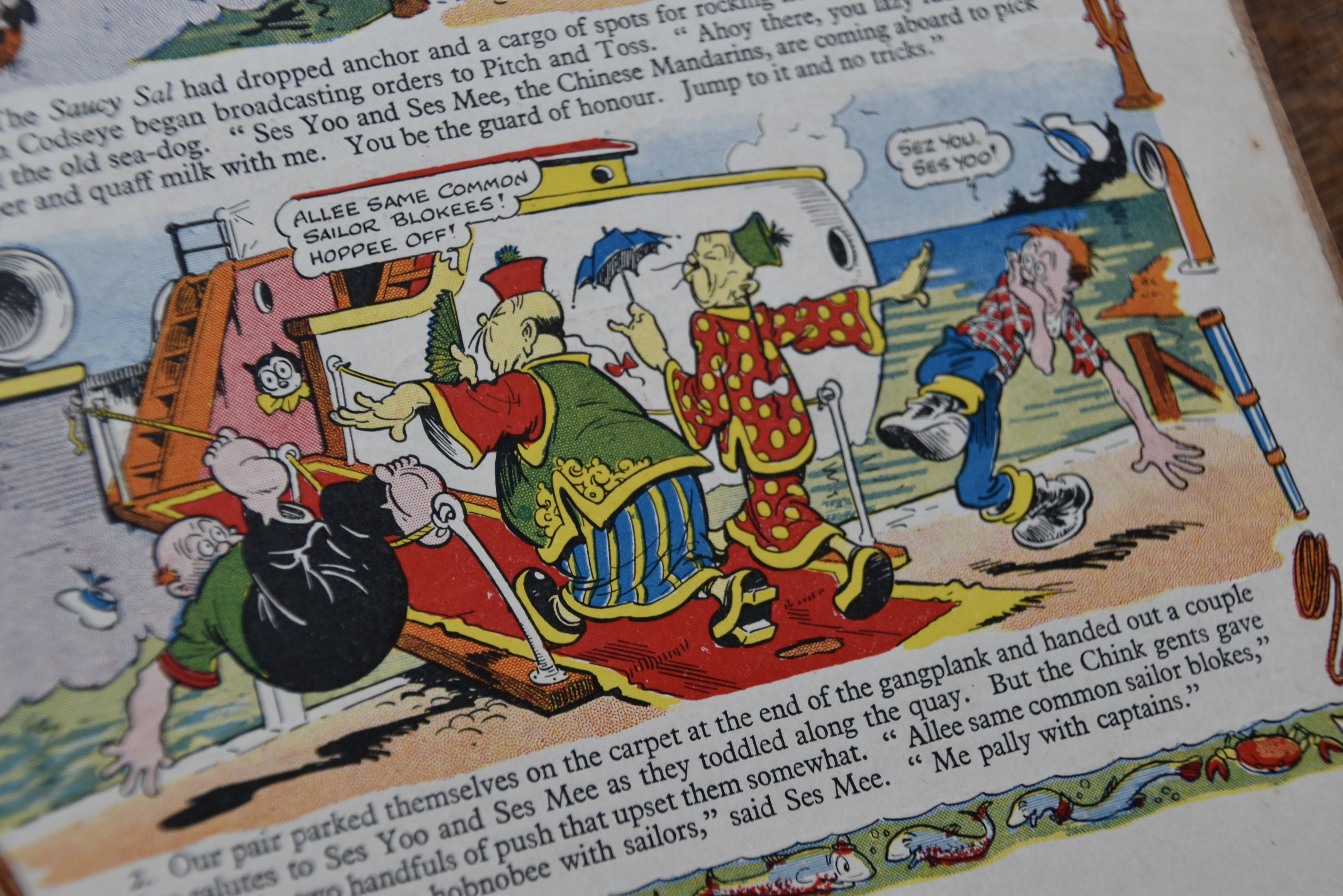
It cost 2/6, for which readers were treated to 110 pages (not counting the covers). Of those internal pages, nine were in colour, including this wonderful full-page gag illustrated by Roy Wilson. Wilson also drew that stunning front cover, of course.

Advertisements for the annual began appearing in The Funny Wonder in early September 1934. The editor, in the regular 'News From Your Editor' section published in #1069 (22nd September 1934) said "it is the funniest book on the market". 

"My dear readers - I wonder how many of you have seen the Funny Wonder annual for 1935? Those of you who have will know how jolly good it is!"

"Your old friends, Pitch and Toss and the Captain, appear inside, with a number of other fun-merchants and the stories are all written by your favourite Funny Wonder authors! All for half-a-crown!". 

Here are a couple of those adverts:


Moving along inside, and the next page we are greeted with is this letter from The Editor. I do wish the editor was named so I could tell you who it was, I also wonder if it is the same editor for the weekly comic. I assume it would be. I like this third paragraph here, promoting the "weekly blue-coloured paper The Funny Wonder".


The book is a wonderful mixture of stories, comics, puzzles and pictures - a fantastic annual that really utilises the space it has. For me, the highlights of this book are the full-page illustrations by Roy Wilson, the king of slapstick. There were two others printed throughout the book in addition to the full-colour one show above, both with black and red ink. Oh how I wish these were also printed in full colour, but of course doing so was expensive in 1934 and colour had to be used sparingly. Wilson was a master of the craft and I certainly haven't written enough about him on this blog. So significant was his work, and at such an important identity-forming time for British comics, I don't think it would be unfair to say that his style and legacy live on through artists working today.


There are plenty of text stories covering a variety of exciting genres, from far-away adventures to mysteries, this book has everything. Any child would have spent hours pouring through them, they really are fantastic. They vary in length so I'll show a shorter one - The Automatic Man. This has it all - a robot, a burglar, and a fat reward!


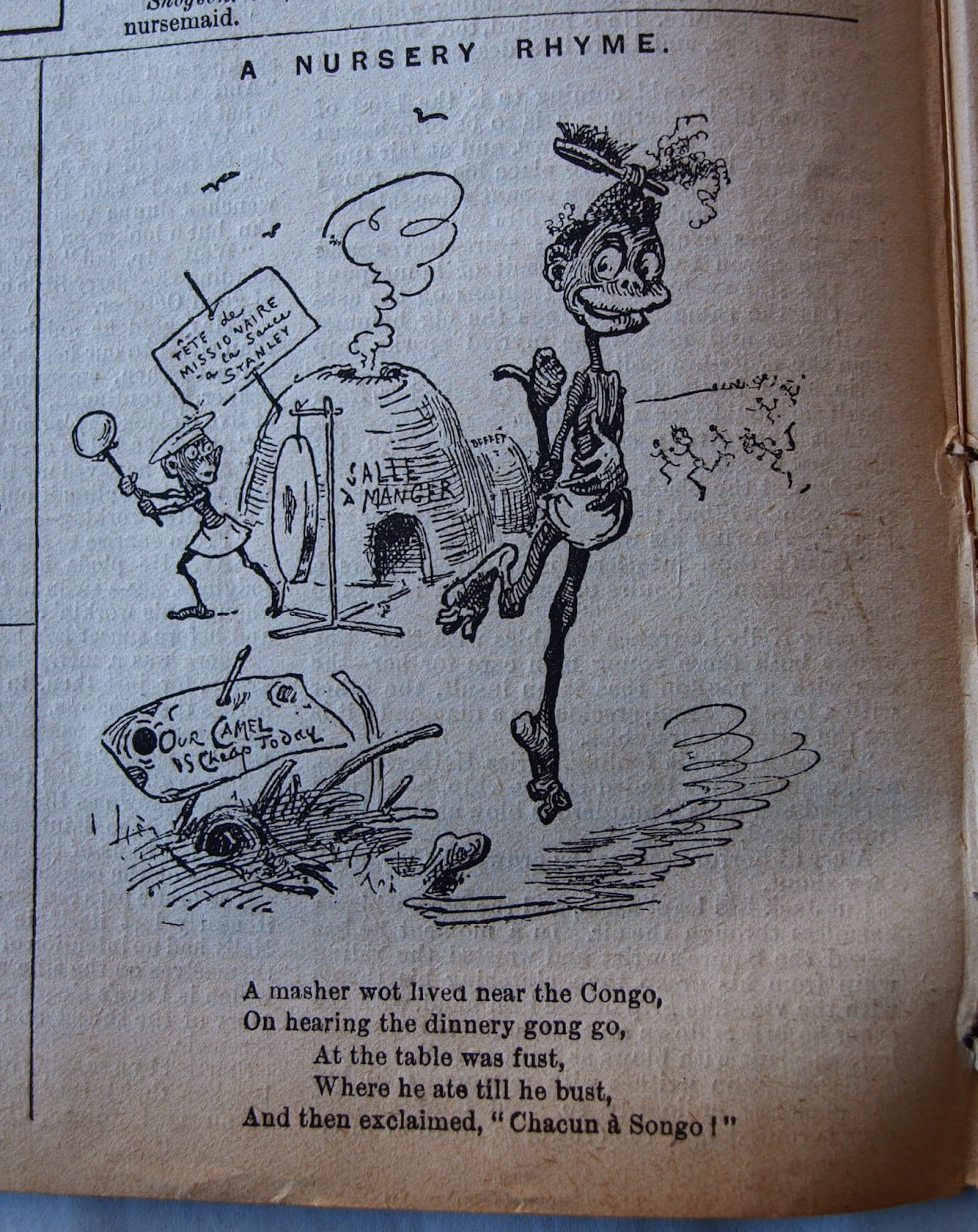
Before moving on, I feel I would be remiss if I didn't at least mention the racism in the comic. Sadly there are a couple of instances, shown below, where racial stereotypes were used. I get that such depictions were somewhat commonplace in comics of the time, but nonetheless they do dampen the comic when looking back. I'm glad times have changed.


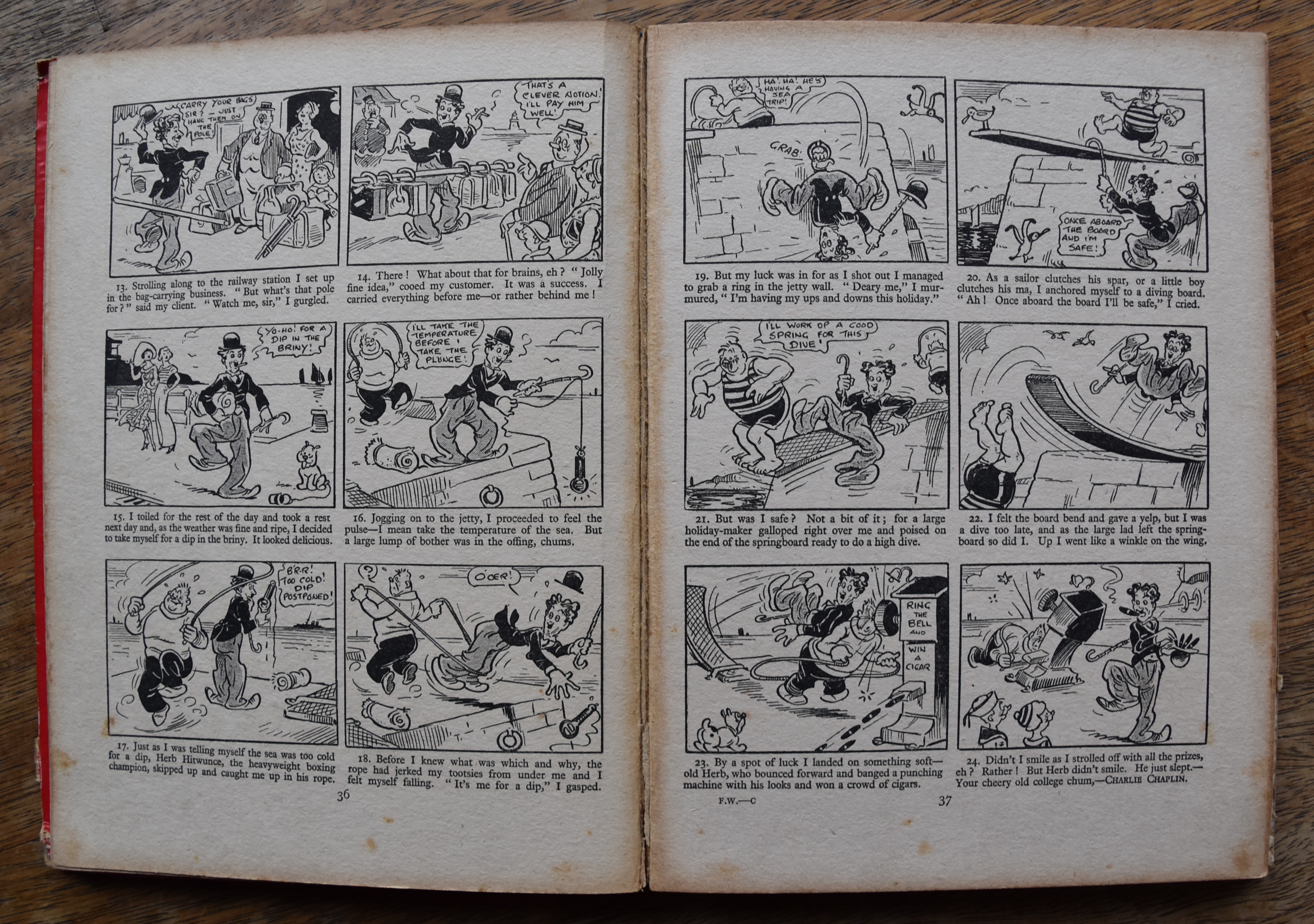
On a lighter note, here's a fun Charlie Chaplin comic strip, partially coloured in by a previous and enthusiastic owner of the book. Chaplin was a regular in The Funny Wonder at this point, with a comic strip on the centre spread every week. It's interesting that the comic has a summer beach theme, given the book was released with intentions of being a Christmas present. It works for those of us in the southern hemisphere, I suppose.


There's also a character called Pearl Pryor in the strip Pranks in the Park who looks incredibly like Keyhole Kate! No copyright claims can be upheld here of course as The Dandy, and Keyhole Kate, didn't arrive on the scene until 1937.


There's plenty more for readers of course but I'll wrap it up for this blog post. The last thing I want to share is this wonderful back cover, advertising various comics published by Amalgamated Press at the time. The Funny Wonder is on there, of course, alongside Larks, Jester, Jingles and Tip Top, each coming out on various days of the week. I love these early comics and wish they were easier to find copies of these days. I know if I had been alive in 1934 I would always be broke!

Saturday, July 12, 2014

Larks No.22 (1928)


As promised last Friday I said I'd take a look at an issue of Larks from the Amalgamated Press version, published from 1927 - 1940, only cancelled due to the outbreak of World War Two. My earliest issue comes from 1928 and is #22. As you can see from the front cover above the cover stars were not a fat 'n' thin tramp duo as was so popular at the time, but instead was 'The Merry Adventures of Dad Walker and His Son, Wally'. Illustrated by Bertie Brown, this duo would enjoy tremendous success, appearing on the front cover of all 656 issues, although the title soon lost 'the merry adventures of' part.

Like just about all comics of the time Larks had half of its pages featuring text stories and the other half with comic strips and illustrations  - the covers and centre spread featuring the strips. This issue features the first episode of a new text story Neddy, Nobby, and Nan, as advertised in the strapline on the cover. This page also includes a letter from the editor, or 'The Editor's Corner', as they called it. In the letter the editor, Stanley Gooch, talks about a new "Wild West adventure" tale entitled 'The Smiling Kid Arrives' beginning in the following issue.


On the opposite page at the end of another text story (entitled Just Like His Dad) was a small advert for Champion, advertising a "free war card" to be given away in every issue for the next month. World War One had of course ended just less than ten years earlier but Britain was still affected by it so no doubt readers, even if they didn't remember the war itself, would be interested in such gifts.


The back page stars Reggie and Roger, or 'The Rollicking Rambles of Reggie and Roger', to give it its full title. Although actually illustrated by Alexander Akerbladh it looks as though he was, like so many other artists of the day, told to draw in the style of Roy Wilson. Reggie and Roger would enjoy long lives in Larks, leaving its pages only two years before it came to an end itself.

Friday, July 4, 2014

Larks! No. 1 (1893)


Back in 1893 Gilbert Dalziel, who had made his name launching Ally Sloper's Half Holiday in 1884, added a sister comic to his lineup. It was called Larks, and was boasted as "the best of the halfpenny comics", an early comic that was part of the "comic boom", started by Alfred Harmsworth when he launched his halfpenny Comic Cuts in 1890. The cover stars are of huge historical importance. Illustrated by George Gordon Fraser the strip is entitled The Ball's Pond Banditti and they are the first regular child stars of any comic. Sure, children had appeared before but only as one-off characters and almost always as troublemakers who were frowned down upon by readers, but The Ball's Pond Banditti showed a bunch of children having fun. They even smoked and carried guns, two things that would never be allowed today, unless the gun was a water pistol of course. It was a brave move by Dalziel to put them on the cover, especially as Larks, and all comics of the time, were aimed at adults. Perhaps he did consider it a mistake, for they were removed from the cover the following year.

Inside, the paper starts off with an introductory letter from Gilbert Dalziel himself. In it he freely admits that Larks is almost identical to Half Holiday, and that in nine years he hopes that they will each sell as many copies per week. At half the price for the same content it seems surprising at first that Larks wasn't as popular as Half Holiday, but of course it didn't have Ally Sloper's iconic figure backing it up.


As was standard with comics of the time, Larks is eight pages, four are mostly text and four are mostly pictures, the front, back covers and the centre spread having the pictures and the rest the text. Besides the letter the text probably isn't of much interest to readers here so instead I shall skip to the centre spread. There's nothing particularly special on it, just one-off cartoons or strips, but here's a few examples.


Although dated Monday 1st May 1893, Larks actually came out on Friday 28th April, and every Friday from then on, dated for the Monday. It revamped in 1902 and folded on 29th December 1906, after 701 issues had been produced. Amalgamated Press published another comic of the same name from 1927 - 1940, but the two comics are unrelated. I do have an issue of this version which I'll show some time in the next week or so.

This is probably the rarest comic in my collection. Besides the one in the British Library, I know Denis Gifford had a copy that may have been the one sold at auction in 2005, meaning that there are three, maybe four, copies known to exist.