Showing posts with label Amalgamated Press. Show all posts

Wednesday, July 12, 2023

The First Funny Wonder Annual


The very first Funny Wonder book came out for 1935, a super-sized edition of the popular weekly comic published by Amalgamated Press. The comic began life in 1914... sort-of, and would continue until 1953. It was actually the second comic to have the name, the first of which was published in the 1890s by Harmsworth Brothers. I'll leave it at that as it's a long and confusing history that I am still wrapping my head around and is probably more deserving of its own post - all you need to know is this is from the second run.

Just from looking at it, I can tell this book would have stood out on any shelf of a 1930s newsagents. Look at the photo above and you can see just how bright it appears when compared to the regular weekly edition. Measuring an inch cover to cover it's also incredibly thick, with pages so heavy they are essentially cardboard.


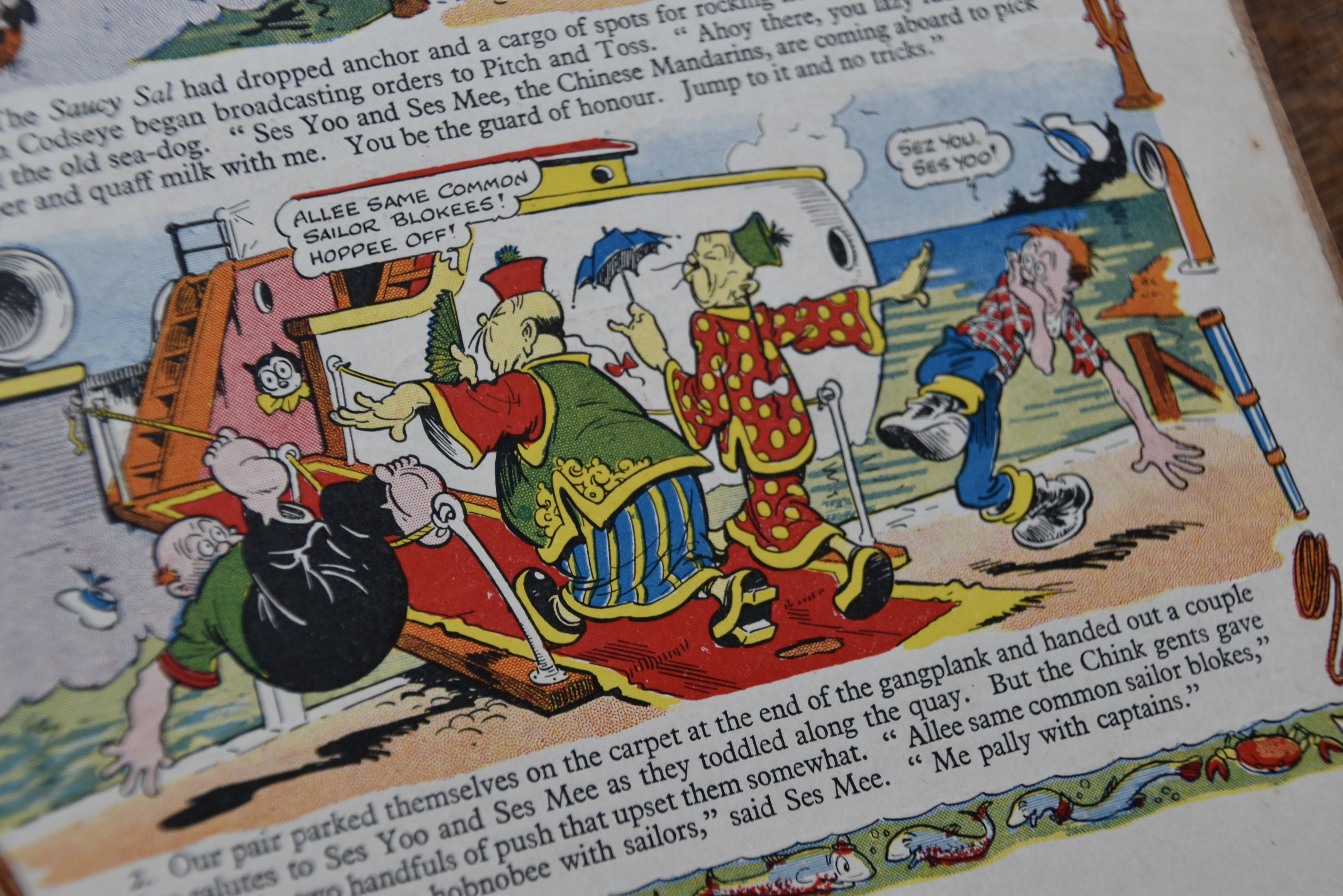
It cost 2/6, for which readers were treated to 110 pages (not counting the covers). Of those internal pages, nine were in colour, including this wonderful full-page gag illustrated by Roy Wilson. Wilson also drew that stunning front cover, of course.

Advertisements for the annual began appearing in The Funny Wonder in early September 1934. The editor, in the regular 'News From Your Editor' section published in #1069 (22nd September 1934) said "it is the funniest book on the market". 

"My dear readers - I wonder how many of you have seen the Funny Wonder annual for 1935? Those of you who have will know how jolly good it is!"

"Your old friends, Pitch and Toss and the Captain, appear inside, with a number of other fun-merchants and the stories are all written by your favourite Funny Wonder authors! All for half-a-crown!". 

Here are a couple of those adverts:


Moving along inside, and the next page we are greeted with is this letter from The Editor. I do wish the editor was named so I could tell you who it was, I also wonder if it is the same editor for the weekly comic. I assume it would be. I like this third paragraph here, promoting the "weekly blue-coloured paper The Funny Wonder".


The book is a wonderful mixture of stories, comics, puzzles and pictures - a fantastic annual that really utilises the space it has. For me, the highlights of this book are the full-page illustrations by Roy Wilson, the king of slapstick. There were two others printed throughout the book in addition to the full-colour one show above, both with black and red ink. Oh how I wish these were also printed in full colour, but of course doing so was expensive in 1934 and colour had to be used sparingly. Wilson was a master of the craft and I certainly haven't written enough about him on this blog. So significant was his work, and at such an important identity-forming time for British comics, I don't think it would be unfair to say that his style and legacy live on through artists working today.


There are plenty of text stories covering a variety of exciting genres, from far-away adventures to mysteries, this book has everything. Any child would have spent hours pouring through them, they really are fantastic. They vary in length so I'll show a shorter one - The Automatic Man. This has it all - a robot, a burglar, and a fat reward!


Before moving on, I feel I would be remiss if I didn't at least mention the racism in the comic. Sadly there are a couple of instances, shown below, where racial stereotypes were used. I get that such depictions were somewhat commonplace in comics of the time, but nonetheless they do dampen the comic when looking back. I'm glad times have changed.


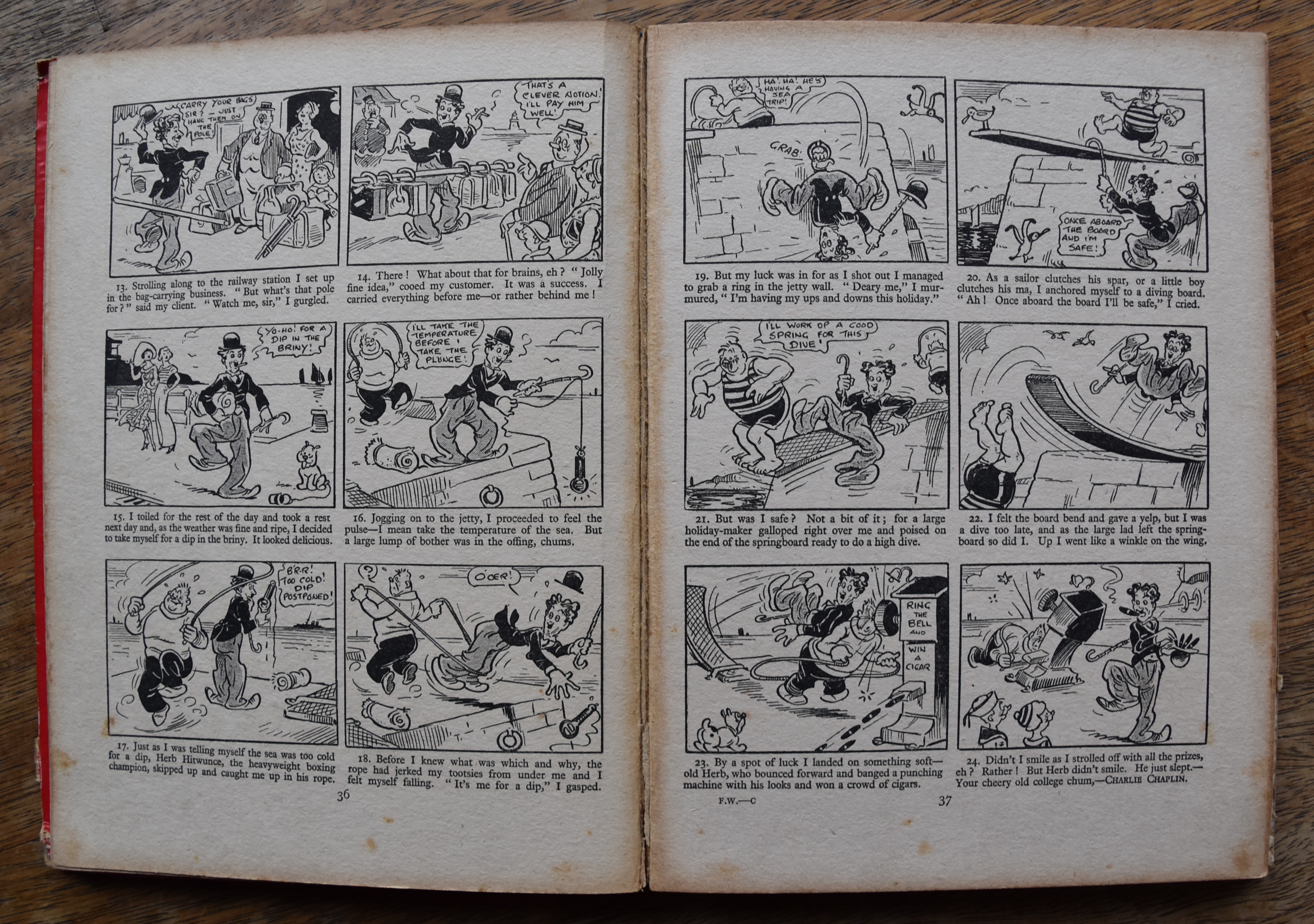
On a lighter note, here's a fun Charlie Chaplin comic strip, partially coloured in by a previous and enthusiastic owner of the book. Chaplin was a regular in The Funny Wonder at this point, with a comic strip on the centre spread every week. It's interesting that the comic has a summer beach theme, given the book was released with intentions of being a Christmas present. It works for those of us in the southern hemisphere, I suppose.


There's also a character called Pearl Pryor in the strip Pranks in the Park who looks incredibly like Keyhole Kate! No copyright claims can be upheld here of course as The Dandy, and Keyhole Kate, didn't arrive on the scene until 1937.


There's plenty more for readers of course but I'll wrap it up for this blog post. The last thing I want to share is this wonderful back cover, advertising various comics published by Amalgamated Press at the time. The Funny Wonder is on there, of course, alongside Larks, Jester, Jingles and Tip Top, each coming out on various days of the week. I love these early comics and wish they were easier to find copies of these days. I know if I had been alive in 1934 I would always be broke!

Thursday, June 22, 2017

The Big New Year


I've blogged about The Big One before, quite a long time ago when this blog was just starting up, when I shared some pages from the last issue. A short-lived experimental comic published by Fleetway, The Big One lasted only 19 issues from 17th October 1964 - 20th February 1965 and, as the name suggests, is the biggest comic ever published in Britain (and maybe even the entire world). With the exception of the front cover of the last issue, the entire contents consisted of reprinted material from earlier Amalgamated Press comics. The front cover features Smiler illustrated by Eric Roberts. Smiler has originally appeared under the strip's original name 'Mike' in both Knockout from 1945 - 1957 and then in Sun from 1957 - 1959. 

Besides Shiner only a handful of strips had a new year's theme. Two of those appeared on the back page in full colour. Handy Andy at the top is an ex-Knockout strip illustrated by Hugh McNeill, and at the bottom Georgie the Jolly Geegee is from the pages of Radio Fun, illustrated by John Jukes. The layout of this back cover reminds me very much of the back of early Buster comics. It's bright appealing colours would be gone by the last issue though, replaced with nothing more than black and red ink.


The Big One Birthday Club is the only editorial feature inside and it offered readers the chance to win big prizes. The letter claims that "week after week hundreds of parcels leave the Club store on their way to members of the Big One Club", but I wonder how much of an exaggeration this is seeing as the comic lasted less than five months. The section also says members will receive a special red and gold club badge. I wonder if any still exist.


The idea behind the comic was that it's size would make it more noticeable than anything else on the newsstands, driving up sales. Of course no newsagent in their right mind would stock it as it is, and they were all folded in half then half again, making them the same size if not slightly smaller than other comics at the time. To get an idea of just how big an unfolded copy is, here's a photo of this issue next to a random issue of Buster (the closest comic I had). Now imagine having that open and trying to read it anywhere with even a slight breeze - it's next to impossible! It's big size was ultimately its downfall, it merged into Buster on 27th February 1965.


Sunday, April 10, 2016

Film Fun No. 1 (1920)


I have just realised that on this blog I have never covered an issue of Film Fun, so what better way to fix that than to look at the very first issue, from 17th January 1920. Film Fun would go on to be a very successful comic, and in April 1920 was joined by its sister paper The Kinema Comic, created to use up any stars Film Fun had missed so that Amalgamated Press had no competition and dominated the market.

The front page featured a strip entitled 'The Adventures of Winkle, the Pathe Mirth Wizard', illustrated by Tom Radford and probably written by his brother William. The strip continued over on the back cover.


For their 1 1/2D readers got twenty black and white pages, and this first issue came with a free "plate" of Fatty Arbuckle. Fatty Arbuckle appeared on page two as a text strip, and would grace the front cover of Kinema Comic as a comic star later that year. The story was supposedly "Written by 'Fatty' Himself", but I don't think that's true in this instance. Most celebrities were used without permission or knowledge but a few did get on board and help out from time to time. Of course, Fatty didn't last long in either papers due to a huge scandal in 1921 where he was accused of rape after someone died at one of his infamous drunken parties at a San Francisco hotel. 


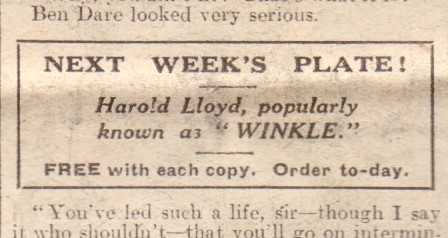
Issue two's free gift would be a plate of Harold Lloyd. Personally I'd have given away Lloyd's gift with the first issue as he is the cover star, and Arbuckle's in the second. Here's the advert for the gift, a tiny panel that appeared in the middle of page 12.


Moving onto the comic strips, page nine featured Mack Swain, another fat film star of early cinema. Art is by George Wakefield.


Harry Parlett, Reg Parlett's father, was also a contributor of this first issue, drawing a number of strips including this Slim Summerville page.


Film Fun wouldn't end its astonishing run until September 1962, producing 2225 issues. It would merge into Buster, where the name would stick until 29th June 1963. By the time it died Film Fun looked very dated. Sure, it had added red to its covers but by the 1960's any comic without a full-colour cover looked old fashioned and dull, hidden behind far brighter comics such as The Beezer, The Topper and Buster. 

Monday, August 25, 2014

Whizzbang Comics


Whisk yourself back in time and imagine being a young boy or girl waking up on the Christmas morning of 1942, slap-bang in the middle of the war, and being given a bright comic annual with the fantastic name of Whizzbang. Yes, the first Whizzbang Comics annual came out in 1942 and is known as the 1943 annual. It was the first of two and both are now quite scarce as due to paper shortages and restrictions print runs were very low. It was published by Amalgamated Press and was not based on any existing comic. There was a one-shot comic called Whizzbang Comic published by Philmar in 1948 but it is unrelated - I wonder if it took inspiration for its name from this annual.

The front cover is illustrated by Roy Wilson and features something that would not be allowed nowadays - smoking. I can spot no less than 5 cigars and pipes. Roy illustrated a number of inside strips as well - I'm fairly certain this Whiskers page, also about smoking, is by him.


As you would expect with an annual from this time there is a good mixture of comic strips and text. Of the 114 pages (including the covers) 6 are blank, 46 1/2 are comic strips/illustrations, 1 (the back cover) is an advert and the rest is text. I'm afraid I can't give the original price, as, unless my copy is missing the front page, it isn't mentioned. Here's the advert from the back cover.


Let's head back to the start of the book, and take a look at the first comic strip. Roy Wilson illustrates The Lad With Taking Ways, underneath a nice header.


Throughout the book there can be found several adventure strips, the first entitled Red Rider. It's four pages in length but I'll only show the first page. I've no idea who the illustrator is; it's a shame the panels were printed so small - it's hard to see all the detail.


The last pages I'll show come in the form of this two-page spread. It features no less than three comic strips and a puzzle at the bottom.


This was a generally enjoyable book. I'd recommend trying to find a copy but going by the price reached earlier this year on Compal Comics of £220 for both books it looks like you'd have to have deep pockets, unless you're lucky enough to stumble upon one in a second hand bookshop or somewhere similar.

Sunday, July 13, 2014

Comic Cuts in America

Issue #9, the last issue.

Comic Cuts is a well-known title here in the U.K, as it ran for over 60 years and produced over 3,000 issues, but it seems widely unknown amongst British comic fans that there was also an American version published, the first issue of which was dated for May 19th 1934. It was published by H.L. Baker and Co (made up of H. Baker and Hake Geller), and they gained the rights to a number of comic strips published in Amalgamated Press’ comics. The U.S. version had a full-colour front cover and so looked much more modern that its British counterpart. Each issue was 24 pages and cost five cents, but “The National Comic Weekly” (as it was subtitled) failed to catch on and just nine issues were released, the last one dated 28th July 1934. 

Sadly, no library is known to have any issues in any collections, and the only reference found on the comic in any book is on page 11 in 'Of Comics and Men', and it states:

"...a five-cent tabloid weekly reprinting the contents of an eponymous British publication that appeared in nine issues between May and July 1934".

It is also listed in 'The Library of Congress Copyright Office, Catalog of Copyright Entries, Part 2, Periodicals, January - December 1934'. It is mentioned three times in the list, here are all three:


As you may be able to see from the cover at the top of this post they didn't just reprint strips from Comic Cuts (in fact, I'm not sure if they reprinted anything from Comic Cuts), for the cover features The Bunty Boys, a strip illustrated by Herbert Foxwell in Bubbles from 1921 - 1941. The only other strip that I know appeared in the comic is Peter the Paleface Brave, also a reprint from Bubbles, this time illustrated by Anton Lock. It seems that this version of Comic Cuts was aimed at a much younger audience than the British version and therefore it reprints material from Amalgamated Press' younger comics.

Sadly information and issues on this comic are hard to come by but if you do know a little bit more about the contents of it, or even have an issue or two, please do get in touch.

Saturday, July 12, 2014

Larks No.22 (1928)


As promised last Friday I said I'd take a look at an issue of Larks from the Amalgamated Press version, published from 1927 - 1940, only cancelled due to the outbreak of World War Two. My earliest issue comes from 1928 and is #22. As you can see from the front cover above the cover stars were not a fat 'n' thin tramp duo as was so popular at the time, but instead was 'The Merry Adventures of Dad Walker and His Son, Wally'. Illustrated by Bertie Brown, this duo would enjoy tremendous success, appearing on the front cover of all 656 issues, although the title soon lost 'the merry adventures of' part.

Like just about all comics of the time Larks had half of its pages featuring text stories and the other half with comic strips and illustrations  - the covers and centre spread featuring the strips. This issue features the first episode of a new text story Neddy, Nobby, and Nan, as advertised in the strapline on the cover. This page also includes a letter from the editor, or 'The Editor's Corner', as they called it. In the letter the editor, Stanley Gooch, talks about a new "Wild West adventure" tale entitled 'The Smiling Kid Arrives' beginning in the following issue.


On the opposite page at the end of another text story (entitled Just Like His Dad) was a small advert for Champion, advertising a "free war card" to be given away in every issue for the next month. World War One had of course ended just less than ten years earlier but Britain was still affected by it so no doubt readers, even if they didn't remember the war itself, would be interested in such gifts.


The back page stars Reggie and Roger, or 'The Rollicking Rambles of Reggie and Roger', to give it its full title. Although actually illustrated by Alexander Akerbladh it looks as though he was, like so many other artists of the day, told to draw in the style of Roy Wilson. Reggie and Roger would enjoy long lives in Larks, leaving its pages only two years before it came to an end itself.

Tuesday, May 13, 2014

Crackers Annual 1935


Last year I took a look at the first two issues of Crackers in two separate posts (they can be found by searching 'Crackers' in the search bar on the right), and earlier this week I picked up the above Crackers Annual 1935 from a secondhand shop for the equivalent of £2.50. It's in very tatty condition with four pages missing, so I'm not surprised it's so cheap. Back in 1934 though, when the book went on sale, it cost 2/6 which must have seemed like a bargain because it is so thick - approx. 3.5cm, but it is made up of just 114 pages (including the covers). Each page is very thick, printed on thin card (perhaps to create the illusion that the book contained more than it actually did).


The annual starts off with a colour plate, as many annuals did back then, this one featuring a variety of exotic birds. It is signed 'O.A.' in the bottom right corner, but other than that I don't know who the artist is.


A letter from the editor followed this, another standard addition to early annuals that gradually died out. It stated that the editor's dog (aptly named Crackers) had been given a bone but it was hidden somewhere in the book. Readers were invited to follow Crackers as he looked for it, and he appeared on almost every other page until he found it right at the back of the book. It really was a bonus story, and a very nice feature.


Most of the book was made up of text stories but there were a few comic strips in there. One such strip was Milly - The Merry Maid of all Work, illustrated by Reg Parlett.


There were a few pages in the book printed on higher quality paper, and these have remained much whiter than their card counterparts. Amongst other strips and stories were these nice full-page illustrations, perhaps drawn by Roy Wilson.


I'll wrap up this post with the 'History Tells Us That-' page. A tramp here can be seen reading a copy of another Amalgamated Press comic of the time - Larks.