Sunday, January 30, 2022

An Interview With Tom Paterson

Some of you might remember back in the days this blog published a bit more frequently I also put out a comic fanzine called Atomic Comic. Fanzines are a LOT of hard work and issue three was certainly the hardest, especially as we decided to print physical copies of this one. Anyway, it was always something I was proud of and I recently came across my copy of it when going through a stack of comics and remembered the interview I had with the great Tom Paterson. Since most people don't have a physical copy (I can't remember how many we sold, but I do remember taking a loss on each one!), I thought it would be a valuable exercise to share the interview on this blog too. This interview is originally from 2016. Enjoy!


I'll start by asking about the smelly sock. It has become the most famous piece of heavily scented footwear in the world but why do you include it in all your comic strips? What was the inspiration for it?

Well, obviously, it's a fundamental symbol of democratic solidarity isn't it? Everybody gets smelly socks... from the humblest tramp to the highest lord in the land... I mean, even the Queen gets smelly socks - in fact, not a lot of people know that her man has got a right pair of pongers humming away inside those great steaming green wellies she's always clomping around the Highlands in! Naah... actually, I used the smelly sock as a kind of trademark because when I started drawing comics, the artists weren't allowed to sign their own names on their work, and I chose a smelly sock because it was a daft little thing that made me laugh... then again, maybe I'm very easily amused!

And of course, you've also got the 'Little Squelchy Things' that appeared in a large amount of your calamity James strips - how did those come about?

I first came up with the Little Squelchy Thingies at school - my old notebooks and sketchpads were covered with them. Later, I was reminded of the, when the great Leo Baxendale started putting little squiggly creatures in-between the frames of some Sweeny Toddler stories, and decided that I could use the Squelchies to inject more humour into my own strips. When I began drawing Calamity James for The Beano, I thought that a James was so con genetically unlucky, he would naturally be plagued by some kind of annoying pests and the Little Squelchy Thingies fitted the bill perfectly and, of course, they proved very popular and were great fun to draw. 

What was your very first published work and where did it appear?

Hmmm... not sure about the first published work, but the first strip I was asked to draw for Fleetway was called Biddy's Beastly Bloomers - a story about a little girl who had three horrible, gluttonous Triffid-like pet plants which was originally drawn by Sid Burgon. Sid was a terrific artist and he had a unique drawing style that I was asked to reproduce. Unfortunately, at the age of 17, I really didn't have a clue what I was doing and I made an embarrassing, ghastly mess of it... it was so bad, it's a miracle they gave me more work!

In the 1970s you drew a fire pages of a strip called 'The Dangerous Dumplings' for D. C. Thomson but you instead ended up working at Fleetway/IPC. What caused you to change?

When I was 16, I sent some examples of my work to D. C. Thomson's and was very surprised when the Albert Barnes, the legendary editor of The Dandy, visited me at my mum's house and asked me to draw a new strip called The Dangerous Dumplings. Now, for a young lad, Albert Barnes was a very distinguished and intimidating gentleman, looking like a retired ex-army major (actually he had been in the navy). Anyway, he wanted me to draw the Dumpling family with large, prominent chins, (he was quite proud of the fact that Desperate Dan's famous chin was based on his own large chin... Albert had quite a thing about chins!) whereas I, with my vast experience, (Not!) was of the opinion that the name "Dumplings" suggested that they should be a flabby, overweight bunch of obese slobs... and so we had a bit of a stand off, during which Fleetway stepped in with the offer of a regular supply of weekly work and that was that. 

When Watford Gapp first appeared in Whizzer and Chips in the late 1980s you used a different style to draw him, which you now use on your current Viz character Jasper the Gasper. What caused this change? Do you have a style you prefer? 

Bob Painter, the managing editor at Fleetway, asked me to come up with a few ideas for some strange, slightly weird strips, one of which was Watford Gapp, and I just thought that it needed an alternative style to give it a different, darker look from my other strips which were running at the same time. I've worked in a number of styles over the years, but I enjoyed the Sweeny Toddler/ Calamity James style, which was of course inspired by the legendary comic genius Leo Baxendale - and the Watford Gapp one, which was influenced by the amazing Robert Crumb. 

You have drawn many characters over the years for various comics. If you could draw any character again, who would it be? Did you ever have a character you would like to have drawn but never got the chance?

I always loved drawing Calamity James and Sweeny Toddler, but I'd really like to have my time over doing Leo Baxendale's brilliant creation, Grimly Feendish. I was asked to draw the strip when I was quite young, but I really didn't have the first idea what I was doing and made a right pig's a**e of it! I'd also have loved to have drawn the unforgettable 'Jonah' and 'Frankie Stein' by the incomparable Ken Reid. Jonah especially used to have me in absolute hysterics... the combination of great scriptwriting and Ken's hilariously manic artwork is simply unsurpassed.

And what inspired you to start drawing? Did you have any artists you looked up to and learned from, or was it just a natural ability that you taught yourself?

I've been fascinated by comics for as long as I can remember. Apparently, I was copying Disney characters around the age of 4 or 5, but the first comic character I really latched onto was "Nick Kelly" in the Topper comic, which was drawn by a great artist named George Martin. I later discovered the beautifully drawn, technically brilliant and fantastically funny work of Leo Baxendale and Ken Reid and I knew what I wanted to do... although the idea of drawing comics for a living seemed a ridiculously remote notion at the time.

What is your all time favourite comic, either to work on or to read?

My favourite comic has always been The Beano, although I also loved Dandy, Beezer and Topper. Later, I discovered the amazing Wham and Smash comics, which were almost entirely the brilliant work of Leo Baxendale. These days I find Viz comic very funny and am lucky enough to have been writing and drawing regular strips for it over the last year or so, which has been really enjoyable. 

Your strips are well known for the many bizarre and random objects lying around, or eccentric millionaires throwing away fivers etc. Were you told to put these in by scriptwriters or are they just added in by yourself whilst drawing up a page? What was the inspiration for these?

All the additional humour and subsidiary shenanigans I always came up with by myself. One of the many things that drew me to Leo Baxendale's work was how, once you'd read the basic story, you could go back time and time again and discover hidden jokes and funny goings-on you'd missed the first few times - his strips were always fantastic value - and Ken Reid's strips were similarly detailed and rewarding. I've noticed how a lot of aspiring artists seem to base their work on the "Cartoon Network" look, and while that works great on telly due to the movement and sound effects, once transposed onto the printed page, it can look very flat, static and one-dimensional. Animation and comic art are two entirely different mediums - a comic artist has to convey the illusion of depth, movement, speed and even sound, and had to add extra character, humour and interest to make the page work on several levels. I would seriously urge any budding comic artist to seek out the superb back catalogues of Leo Baxendale and Ken Redi - if you can't learn anything from those two comic masters - you'll never learn!

You have drawn a lot of pages, but what happens to all the original artwork? Does it all pile up in a corner of your house?

Years ago we used to post the original artwork (I know!) in to the editorial office, so there must be an awful lot of my pages lying somewhere in a leaky warehouse in Dundee - I really must make enquiries about that. (Are you listening, D.C. Thomson?) These days, it's all emailed off so I'm gradually accumulating quite a tower of dusty pages of artwork which is fast becoming a critical space problem - potential buyers, please apply within!

Have you ever considered creating your own comic or annual, such as Leo Baxendale's Willy the Kid books? I'm sure fans would love to see something along those lines from you.

I've had a go at creating my own comic a couple of times, but the problem's been that the nasty, greedy, grasping publishers tend to want to steal all the copyright from the artist for doing exactly f**k-all!

What work do you have planned for the future?

As I say, I'm very happy writing and drawing for Viz at present, although I'd like to get into the children's market again. I recently contributed to Jamie Smart's new venture, Moose Kid Comic, and I'm currently working on a specific idea for another weekly publication, so watch this space!

Before we conclude the interview, have you anything else you'd like to share?

Oh, dear... how much space have you got? I'd just like to say how sad I am at the continuing deterioration (with one or two exceptions!) of the children's comic market. What happened at The Dandy, for instance, was in my opinion, nothing short of criminal. 75 years of unique history and precious comic legacy, lost in a few short years due mainly to catastrophic managerial and editorial decisions - and I fear The Beano is headed down the same dead-end route. For f***'s sake!... please, please let's get rid of this mindless obsession with here-today-gone-tomorrow, tenth-rate, so-called celebrities being palmed off as comic characters! (Note to the dim editors... Alan Titchmarsh, Cheryl Cole and Simon Cowell are NOT and NEVER will be FUNNY!! You're meant to be in the HUMOUR business, remember? Du-u-uhhh!) I'd like to see people back in charge who really understand and genuinely cherish the very special art form that is British comics, and stop relying on useless accountants, vacuous marketing types and pointless focus groups. Instead of giving readers what they THINK they want, let's employ truly creative writers, editors and artists to give them something they can't even IMAGINE! That's what BRITISH COMICS should be all about! Tom Paterson... having a rant... and no f*****g wonder!

Thursday, January 27, 2022

Kidzone (1983)

"Hey kids! Look! The FIRST ISSUE of a Brand New Comic just for you - DON'T MISS IT!!" boasts the front cover of this comic in a fashion typical for the launch of a new title. Indeed, these days it's not often I come across a comic I haven't heard of before, but on a recent trip down south to Dunedin I was lucky enough to come across a couple of issue of Kidzone, a bit of a mysterious New Zealand comic from the early 1980s that is as brand new to me as it would have been to its original young readers in 1983. 

Issue one is dated Friday, August 12, 1983, and for 50c readers got a modest 16 pages, all black and white except the front cover and the back which also had some red, and, perhaps somewhat surprisingly, no adverts. For comparison, an issue of Whizzer and Chips dated 24th September 1983 cost 55c in New Zealand and was twice as thick (I don't have any 1980s Beanos to hand as I write this but if memory serves they were slightly thinner and less expensive than their IPC competitors), but the draw of Kidzone is that it is distinctly and unmistakably a 'kiwi' comic. The front cover character is Mickey's Moa, and a friendly kiwi smiles next to the comic's title just above the price tag. Perhaps something of a New Zealand Big Eggo, Mickey's Moa follows the adventures of Mickey, a young boy who befriends the giant bird after finding him hiding in a cave in the bush. Here's the second page of that strip, illustrated by Robert 'Bob' McMahon. McMahon was clearly Kidzone's main artist and was in fact the driving force behind the comic. In this first issue alone he drew 4 different strips of which all but one were at least a full page.

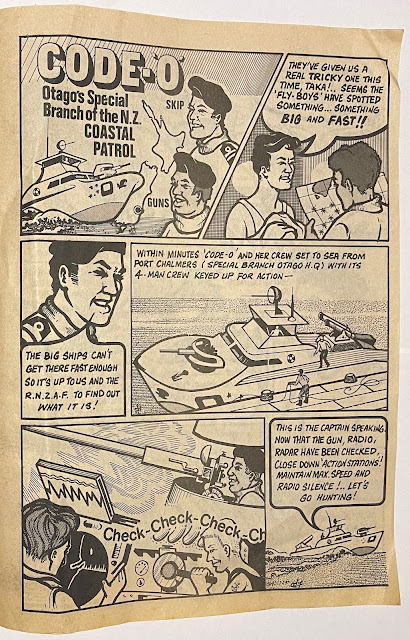
Although inspired by the comics D C Thomson produced (McMahon acknowledges this in an interview, more on that in a minute) the kiwi theme continues inside, another example being the strip Code-'O': Otago's Special Branch of the N.Z. Coastal Patrol (for those who don't know, Otago is a region in NZ's South Island). Although I don't know the artist, a signature does seem to appear in a few of the panels (nos. 4, 6, 7, 10 & 11). 


Here's a name that might be familiar to some of you, Vid Kid. Except not the Vid Kid who graced the pages of Buster from 30th May 1987 through to its final issue, rather this Vid Kid is simply a fan of video games. I believe the artist's last name to be Grundy due to a signature on a later Vid Kid strip in issue #3 but sadly I don't know their full name.

My favourite strip in the comic is certainly this one, Greenslade The Frog - illustrated by the same artist as Vid Kid, the mysterious 'Grundy'. It certainly made me chuckle. 


As far as I know, only three issues of Kidzone were produced and judging by the 9th September cover date of issue #3 was a biweekly publication. I own issues #1 and #3, and interestingly the National Library holds the same copies, also missing the second issue. According to a 2012 interview with McMahon, the print run consisted of just over 1000 copies and used artists from The Otago Daily Times, where McMahon also worked. It was put together in Dunedin and printed in Gore by Gore Publishing but was only distributed as far north as Christchurch, so it certainly had a very limited reach. McMahon was bankrolling the comic himself and was struggling to get a sponsor, and his printers would often push him aside for bigger jobs meaning he would have to run around chasing it up. Despite receiving a positive response in the form of "a lot of letters from kids", it sadly failed to last, McMahon deciding that "nah, I don't need this". Elaborating, he says "it was just barely feeling its way after about a couple of weeks, it was burning me out so I flagged it, I realised that because I was doing the whole thing. I was doing the colourations, chasing people up for their work, going down to Gore and literally printing it, printing it the way I wanted. All this sort of thing and it was too much". It's a shame things didn't work out for Kidzone
 as I believe, by marketing itself as a uniquely New Zealand comic, it could have had some potential had it been able to give itself time to become a bit more of a finely polished product. New Zealand made comics are few and far between so it is always nice to come across one and, in my experience at least, people always like to support local New Zealand artists.

The cover of issue #3, this time with
a green kiwi


For those interested you can read the full interview with Bob McMahon on the Pikitia Press blog here:

Tuesday, September 21, 2021

The Return of Monster Fun

After an absence of almost half a century, the much-loved British comic Monster Fun is making a comeback under its new owners Rebellion. Admittedly, the nostalgia for the title is probably stronger than the love for comic itself during its initial run, only 73 issues of the weekly edition were printed until it merged with the far more successful Buster comic on 6th November 1976. I certainly find it interesting that not a more popular title was chosen for the first Fleetway comic to make a comeback, but I am nonetheless very excited for it. 

No longer a weekly, the revived Monster Fun will begin publishing in April next year with promises of a new issue every two months. The comic will be 32 pages and will feature many of the original favourite characters such as Frankie Stein, Kid Kong and Sweeny Toddler - not all Monster Fun originals but certainly characters who became popular in the comic's original run.


To pass the time until April, the Monster Fun Halloween Spooktacular will be going on sale next month. 48 pages thick, it is crammed full of classic stories from well-known artists, including that spectacular front cover illustrated by none other than Tom Paterson. 

As I understand it, Monster Fun will be available in the stores but online subscribers will receive special free gifts. No word on what those gifts are just yet, but I wonder if they'll be reminiscent of plate wobbler, freaky spider ring or super shaking skeleton that each came with the first three issues of its 70s predecessor. I also wonder if this new version will feature the 'Badtime Bedtime Storybooks' - centre pages encouraged to be pulled out and compiled into mini-comics, much to the bane of collectors today who seek out complete copies. 

Do check out the website and subscribe to make sure you don't miss an issue. 

https://monsterfun.co.uk/

Friday, August 20, 2021

Scoops (1934) and Advertisements for Some Rare Comics

The front cover of Scoops #1, from Compal Comics 
Auctions LTD.

The other night I was browsing through the latest British Comics and Artwork catalogue available on Compal Comics when I came across an interesting title at lot #14, the very first issue of Scoops, dated February 10, 1934. Now, anybody who knows me or has been following my blog for some time will no doubt know that I am fascinated with obscure titles, and this "amazing new wonder weekly" was certainly no exception. The striking front cover stood out to me; I simply had to know more. 

A fantastic illustration from issue #1. I wish I knew the artist's name - if you do please don't keep it to yourself!

Scoops was published every Thursday by Pearson and ran for just 20 issues from 10th February to 23rd June 1934, costing 2D for 30 pages for issue #1, 32 pages for issues #2 - #11, and 28 pages for the remainder of its run. Only the front cover had any colour, with a stunning use of red ink (throughout its short run Scoops had some absolutely spectacular front covers), and its contents were made up of text stories with an accompanying illustration or two. Alongside this were the occasional editorial pages and some full page illustrations. Here are a couple of examples to show you what I mean, both taken from issue #16 dated May 26, 1934. The 'Go-Anywhere Flying Boat' page takes my mind to the cutaway illustrations that would so wonderfully grace the pages of Eagle a couple of decades later. 


Despite its obscurity, Scoops is quite collectable as it is "regarded as the very first specialist anthology of science fiction stories for the UK market" - in fact issue #10 carries the bold strapline 'Britain's Only Science Story Weekly'. It is particularly notable for its publication of the Sir Arthur Conan Doyle's 'The Poison Belt', serialised from issues #13 through to #18. Here's the cover for #13, promoting the first chapter of the story with quite a horrific and graphic illustration.


Indeed, sometimes Scoops is referred to as a comic, which is why it piqued my interest, yet as far as I have seen not a single comic strip was ever printed within its pages. But that's not to say it doesn't contain anything of interest for those of us interested in the comic side of things. As you may know, C Arthur Pearson produced "a comic for all the seasons" (as Denis Gifford put it), and indeed a few of them were advertised within the pages of Scoops. Here's every advert for such a comic I could find, although admittedly I don't have access to every issue I think this is a nice little collection. As with all images on this blog, click on them to view in full size.

From #9

From #11

From #19

From #20

These comics were produced sporadically until the War put a stop to such practices due to paper rationing, and I'd certainly like to dedicate a full post to them at some point in the future but sadly I don't own any issues (if you do and want to sell them, or even just send me some scans, please do get in touch!). In the meantime though, I highly recommend having a flick through a few issues of Scoops. Even if science fiction isn't your thing, admiring the front covers is certainly worth a few minutes of your time. All the scans from here are taken from Comic Book + (I've provided the link below), which has a number of full issues you can download, you'll just need a program to open the files - I used DrawnStrips Reader (but you can even read them without downloading on the website). Scoops was a wonderful magazine with some fantastic writing and illustrations, and certainly a publication lightyears ahead of its time. It really was "the story paper of tomorrow".

https://comicbookplus.com/?cid=2460 

Thursday, April 2, 2020

Buster Comic - 25 Years Young!


Well, before I start this post I thought I'd quickly explain what brought it about. Here in New Zealand our country went into a total lockdown about a week ago as a result of the COVID-19 virus, meaning  pretty much everything except supermarkets and pharmacies have shut and we are all confined to our homes unless visiting essential services. As a result of this lockdown, I have returned home to Auckland to be with my family and was reading the very comic this post is about when I thought hey, why not use this time to do some blogging.

This issue of Buster, dated 25th May 1985, is the celebratory quarter century birthday number for the comic, the first issue of which hit the shops in May 1960. This issue also brought about a new artist for Buster replacing Reg Parlett, who had drawn the strip since taking over from Angel Nadal Quirch in 1974, with Tom Paterson. Many, including IPC group editor Bob Paynter, later thought this change was far too sudden and dramatic and I am possibly inclined to agree - as much as I absolutely adore Tom's style he is so far from Reg Parlett that I bet many readers would have found the sudden change quite a shock. Here is Tom's full strip, printed in full-colour on the back page.


Not having the free gift attached to the front does look a little sad when the whole cover is almost devoted to promoting it. "Incredible... Amazing... Unbelievable!" boasts the big yellow arrow, pointing at an empty blue space. Still, a half page instruction from inside shows those of us reading now just what it was we are missing. The previous issue had hyped them us as 'Deadly Death-Rattler Eggs', but they are certainly not what I would have imagined.


Other than the back-page Buster strip, no other stories made mention of the occasion. The only other indication that this issue held any kind of significance was this mildly interesting comparison of kids 'then and now', comparing interests of children in 1960 and 1985. Personally, I feel dedicating the entire centre page spread to this is a waste of space and the pages could have been better used with something such as a history of Buster, a poster, or a celebratory strip, but each to their own I suppose. It almost seems like they forgot the anniversary was coming up and had to prepare the issue at the last minute.


Since so little of this issue actually celebrates the anniversary I thought I'd show a few pages from the previous week as well, which is also the final combined Buster and School Fun. Although School Fun isn't even mentioned on the cover, this issue still has the School Fun section inside, featuring characters from the now defunct title. A wonderful Reg Parlett front cover hints at exciting things to come next week - quite the build up for what was eventually a bit of a let down. 


Of course, this being Reg's last time drawing Buster I have to show the full strip - printed in full colour on the back page. 


Inside, a full page advert previewed the front cover of next weeks issue, including a picture of the rather exciting looking free gift! The thrilling death-rattler artwork would probably have gotten me to buy it, I'm not going to lie. 


This issue also contains the final episode of The Leopard from Lime Street, a popular character that had been in the comic for almost a decade having first appeared on 27th March 1976. A sad loss to see this one go, it was the final adventure strip Buster ever featured, although it would return in the form of reprints in the 1990's. Artwork by the legendary Mike Western, I believe. 


I hope this brought about a bit of happiness wherever you are in the world. Please stay safe everyone! I'll try keep blogging while I'm quarantined in Auckland with all my comics, so stay tuned.