Tuesday, May 13, 2014

Crackers Annual 1935


Last year I took a look at the first two issues of Crackers in two separate posts (they can be found by searching 'Crackers' in the search bar on the right), and earlier this week I picked up the above Crackers Annual 1935 from a secondhand shop for the equivalent of £2.50. It's in very tatty condition with four pages missing, so I'm not surprised it's so cheap. Back in 1934 though, when the book went on sale, it cost 2/6 which must have seemed like a bargain because it is so thick - approx. 3.5cm, but it is made up of just 114 pages (including the covers). Each page is very thick, printed on thin card (perhaps to create the illusion that the book contained more than it actually did).


The annual starts off with a colour plate, as many annuals did back then, this one featuring a variety of exotic birds. It is signed 'O.A.' in the bottom right corner, but other than that I don't know who the artist is.


A letter from the editor followed this, another standard addition to early annuals that gradually died out. It stated that the editor's dog (aptly named Crackers) had been given a bone but it was hidden somewhere in the book. Readers were invited to follow Crackers as he looked for it, and he appeared on almost every other page until he found it right at the back of the book. It really was a bonus story, and a very nice feature.


Most of the book was made up of text stories but there were a few comic strips in there. One such strip was Milly - The Merry Maid of all Work, illustrated by Reg Parlett.


There were a few pages in the book printed on higher quality paper, and these have remained much whiter than their card counterparts. Amongst other strips and stories were these nice full-page illustrations, perhaps drawn by Roy Wilson.


I'll wrap up this post with the 'History Tells Us That-' page. A tramp here can be seen reading a copy of another Amalgamated Press comic of the time - Larks.


Saturday, May 10, 2014

The Big Budget - Three Comics In One

The Big Budget Vol. 1 No. 1

There was a comic many years before the first issue of Whizzer and Chips came out that was advertised as multiple comics for the price of one. No, not two comics as we are used to seeing (Whizzer and Chips, Shiver and Shake and Score 'n' Roar), but was "Three Papers For A Penny!" The Big Budget was its name, and it was launched on 19th June 1897.

The cover stars were nothing new, a fat 'n' thin tramp duo called Airy Alf and Bouncing Billy. They were, of course, based on Illustrated Chips' ever popular Weary Willie and Tired Tim and were even drawn by the same illustrator, Tom Browne (who still holds the record for highest ever paid cartoonist in Britain - £150 a week in the late 1890's!). A very interesting Airy Alf and Bouncing Billy Strip was the one on the cover of The Big Budget Vol. 5 No. 122, dated 14th October 1899. The episode that week was entitled 'Airy Alf and Bouncing Billy Meet Their Great Rivals', who were named Weary Tim and Tired Willy (see what they did there?)! These rival tramps are even seen reading Chips in the first panel, despite the fact that The Big Budget was published by C. Arthur Pearson and Chips by Amalgamated Press. Interestingly, the strip is illustrated by Ralph Hodgson and not Tom Browne, the latter of whom was to leave comics for good the following year due to too big a workload. Here is the strip in full, which is quite possibly the first crossover in British comics.


As mentioned above, The Big Budget was divided into three sections. The first of these sections was The Big Budget itself, which featured comic strips such as Airy Alf and Bouncing Billy. The second section was entitled 'The Comrades Budget' and the third part 'The Story Budget'. Both of these featured texts stories and features. Perhaps the whole 'three-in-one' technique was too far ahead of its time, because, less than one year into its run on 26th March 1898, they merged into each other and The Big Budget became just another one pence comic, or "penny dreadful" if you will (I personally dislike the term as it was mostly used by critics who hated the publications, but it now seems to be generally used to address the comics and papers). Bringing it back to standard form must have helped it because, despite a loss of pages, The Big Budget thrived for many years afterwards.


Bounderby Bounce, a strip from a 1900
issue of The Big Budget illustrated
by Charles Genge.

In 1904 there was a short spin-off from the regular Big Budget series. The Big Budget Library was launched in January 1904 with high hopes, each issue had a grand 96 pages, all of which was material reprinted from the weekly paper. Sadly, it was a failure and lasted for just two issues.

The Big Budget was more comic centered for most of its life until 1905, when Boy's Leader merged into it and changed it into a dominant story paper. It continued on until 20th March 1909 and produced 614 issues, when it underwent a name change to Comet. This, however, was a failure, lasting just 14 issues from 27th March 1909 to 26th June 1909, after which it was gone forever.


Today, The Big Budget isn't very common, as with most comics of the time, and I've never seen an issue for sale - and I have been looking. The images for this post are scanned from Victorian Comics by Denis Gifford, a 1976 book that has hundreds of illustrations but is very lacking in information. I found any information on The Big Budget hard to come by, all the facts in this post come from at least three different sources - so hopefully you've learnt something! There sadly isn't much interest in comics of this time now, despite their interesting history and [usually] high quality artwork. I'm really getting interested in these older comics prior to 1940 and I have another post of a comic from the mid 1930's planned, so stay tuned!

UPDATE:

There isn't an awful lot to add to this post but I have just learnt that The Big Budget was the first comic in Britain to reprint American newspaper strips.

Friday, May 9, 2014

The Beano and Dandy on Sunday


Both The Beano and The Dandy have now been given away in a Sunday newspaper, The Dandy in July 2011 and The Beano last month.

I'm going to compare the two promotional comics, staring with The Dandy. It was given away in July 2011 inside the Sunday Post and was 32 pages thick and printed on the same quality paper as the weekly - so was no different in style to the regular comic. With the possible exception of the Harry Hill strip (and the "filler" pages) this giveaway is entirely reprint from Dandy strips published after the 2010 revamp (more about that here). This isn't really too much of an issue as the comic is trying to gain the title new readers anyway, who won't have seen the content but for any fans of the comic it is a bit of a let down (but hey, it's free and not aimed at us, so we can't really complain).


One thing The Dandy freebie was missing was a discount or special offer to encourage new readers to hop aboard. Sure, it had the 15 issues for £15 subscription offer (which really was good value for money), but the offer was available to regular weekly readers as well, so nothing exclusive.

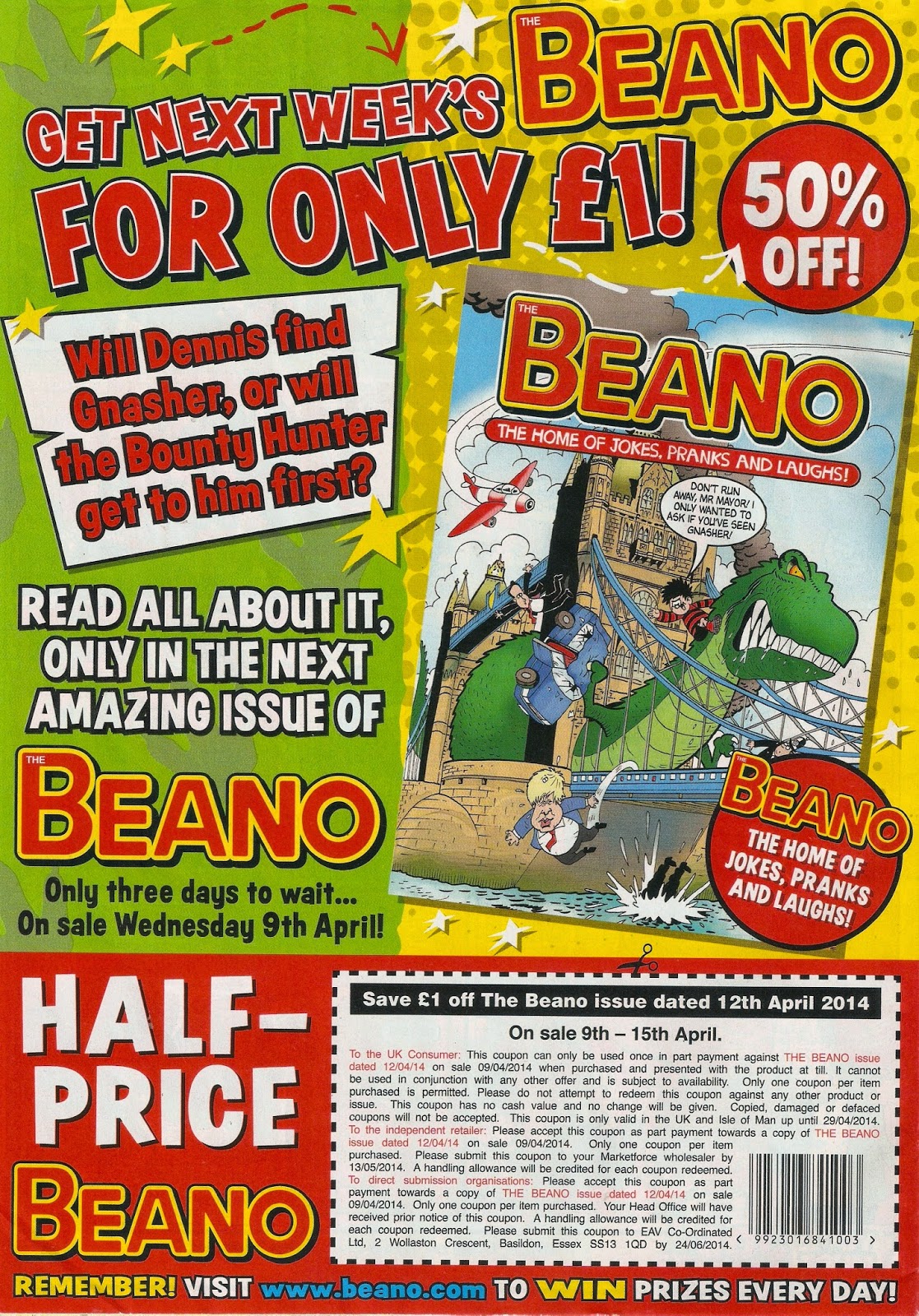
Moving on to The Beano, that was 32 pages so unlike The Dandy equivalent is thinner than the regular comic. However, it does feature all new content that focuses around the main story that was running in The Beano - Gnasher going missing after stealing a dinosaur bone. The content is one continuous story with all the characters working around this main storyline. It seems very well pieced together in this way; even the bounty hunter with his eye patch and grey goatee was drawn the same way by two different artists on two different strips (David Sutherland on The Bash Street Kids and Wayne Thompson on Roger the Dodger). 


Unlike The Dandy, The Beano did offer a special discount to encourage new readers, allowing them to buy the next issue for £1 - 50% off. They also offered a fantastic offer for subscriptions - 15 issues for just £10!


It's good that the story arc wouldn't confuse any new readers too, as the free comic explains it all, so the whole project was very well thought out. Whereas I'm sure the Dandy was a minor success the comic didn't last long afterwards  I can't speak much for the future of The Beano at present, but the results of this free issue are promising, with it been reported that sales increased by 25% and that there are 1,400 new subscribers, so very good news indeed!

Here's the report on the results of the free Beano by D.C Thomson:

http://www.dcthomson.co.uk/media/the-beano-sees-significant-sales-uplift 

Tuesday, May 6, 2014

From The Penny Dreadful to the Ha'Penny Dreadfuller


I'm currently reading Robert J. Kirkpartick's From The Penny Dreadful to the Ha'Penny Dreadfuller. So far it has proven to be an enjoyable and serious read and the best study of children's periodicals I have ever come across, quite possibly the finest and most complete ever compiled. Not only does it cover the history of the children's story papers, but it also looks into the backgrounds of the publishers who made them. Such research has been conducted in the past with the better-known publishers such as Alfred Harmsworth but for many it has never been studied before.

At the back of the book is featured a list of every single story paper published between 1762 - 1950, no matter how short a run they had, listing the title, run dates, publisher, which comic/paper it merged into (if any) and number of issues published. Along with two other lists and an almost 500 page history this just goes to how much time, effort and research has gone into this book.

Although there's sadly no room for every single paper to be illustrated there are a good number of illustrations throughout, all taken from either the author's collection or the British Library.

All this doesn't come cheap, and rightly so. It costs £50 from the British Library website, but the p+p is free as a result. The price was more than I could afford so I requested my local library to purchase it, which they did, so if it is too expensive for you trying this is a great alternative.

https://shop.bl.uk/mall/productpage.cfm/BritishLibrary/_ISBN_9780712309547/87293/From-the-Penny-Dreadful-to-the-Ha'Penny-Dreadfuller-(hardback)

Friday, May 2, 2014

The Broons and Oor Wullie Reproductions


Any fans of The Broons, Oor Wullie or Dudley Watkins will surely be interested in reproductions of the first Broons and Oor Wullie annuals. Originally published in 1938 and 1939 and dated for the following years, the originals are worth a considerable sum and it isn't rare to see them fetching £1000 at auction. That makes these two reprints, published in 2007 by D.C Thomson and Aurum Press, a good affordable alternative. They are a high quality reproduction of the original books, bar the covers and Oor Wullie's title page all the artwork has been restored to how it would have looked originally on bright white paper, so it is pleasing to read and Dudley's artwork is nice and clear.


Asides the date for the copyright information the only other change I noticed was that the reprints are hardbacks whereas the originals were softbacks. I suppose the reason for this change is that the books are made to be more durable, and at £20 for the two of them you'd expect them to be of a high standard. D.C Thomson did produce a few hardback versions of each book originally but these went to Robert Duncan Low, possibly Dudley Watkins and their own files, so were never sold to the general public. 

My copies come in a combined box set but they were also available in individual sleeves, of which The Broons one is still available from D.C Thomson's website for £6. You can pick up a box set, which I would recommend, from ebay - the lowest price currently is £13.63.